
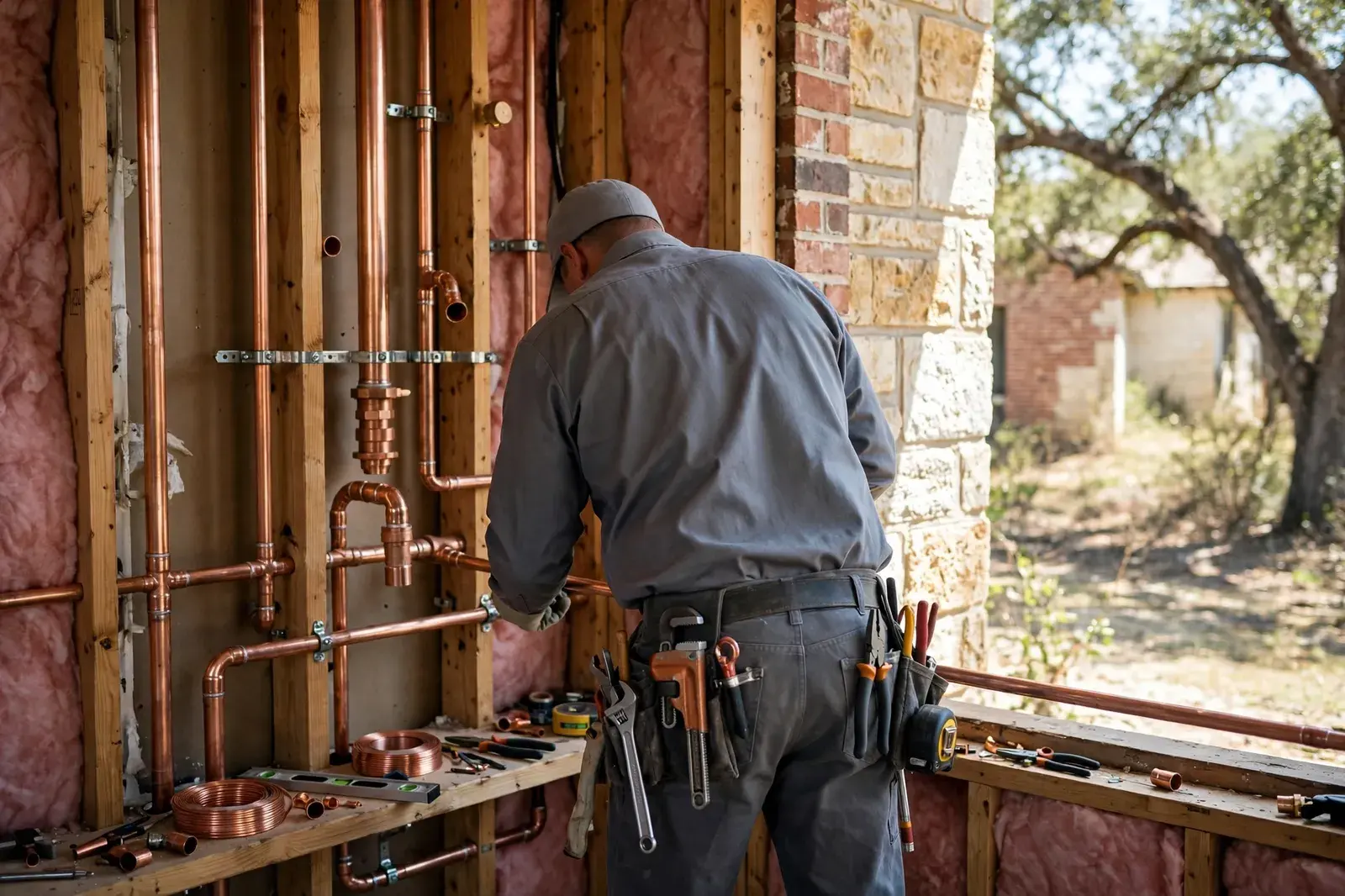
Repiping in Austin, TX
When pipes in Austin leak again and again, lose pressure, or tint the water brown, a repipe replaces them with new PEX or copper throughout the home. The local company maps the system first, then quotes the job in writing. Call (833) 878-1592.
Updated 2026-11-18. Austin, TX · Travis County · Population 993,588. Prices shown are estimates only.
- 993,588 Population
- Travis County
- 75 ZIP codes served
Before & after in Austin
Before & after
Drag the slider to compare the same spot before and after the repair.
Repiping in Austin
Repiping and your water heater in Austin?
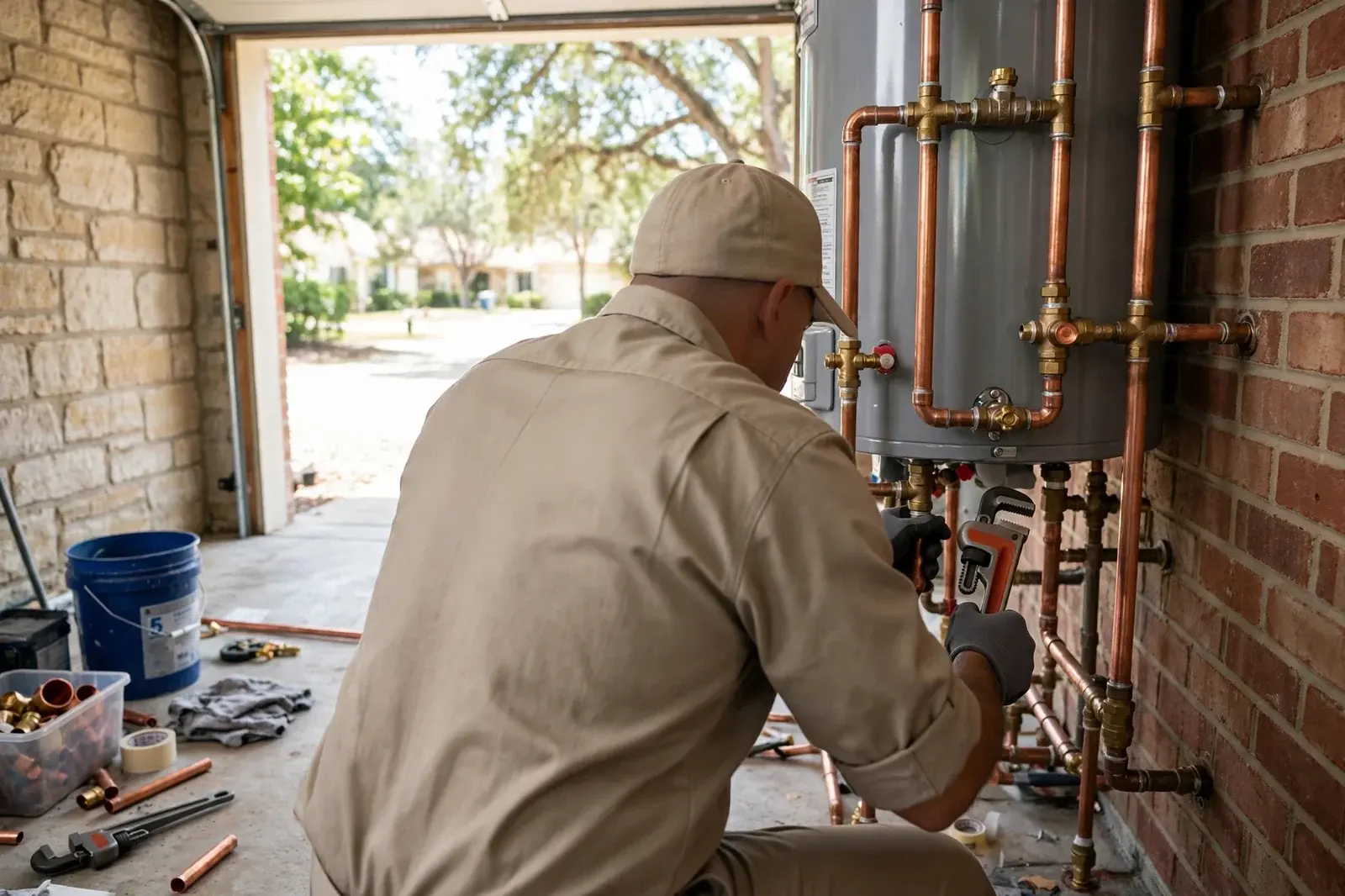
The water heater in Austin is checked during the repipe inspection, and the crew looks at its age, its connections, and whether it is the right size for the home. A heater that is undersized will still leave showers cold, whatever the pipes do, and the crew will say so plainly.
If the heater is sound, it stays, and the new lines are tied into it. If it is failing, the quote should say so and price the replacement beside the repipe, so the homeowner can decide with both numbers in hand.
The heater replacement is listed separately on the quote in Austin, so the homeowner can see what the repipe costs and what the heater costs.
The service area in Austin covers 75 ZIP codes, from 73301 to 78799, all inside Travis County.
Repiping in Austin
After the repipe: what changes in Austin homes
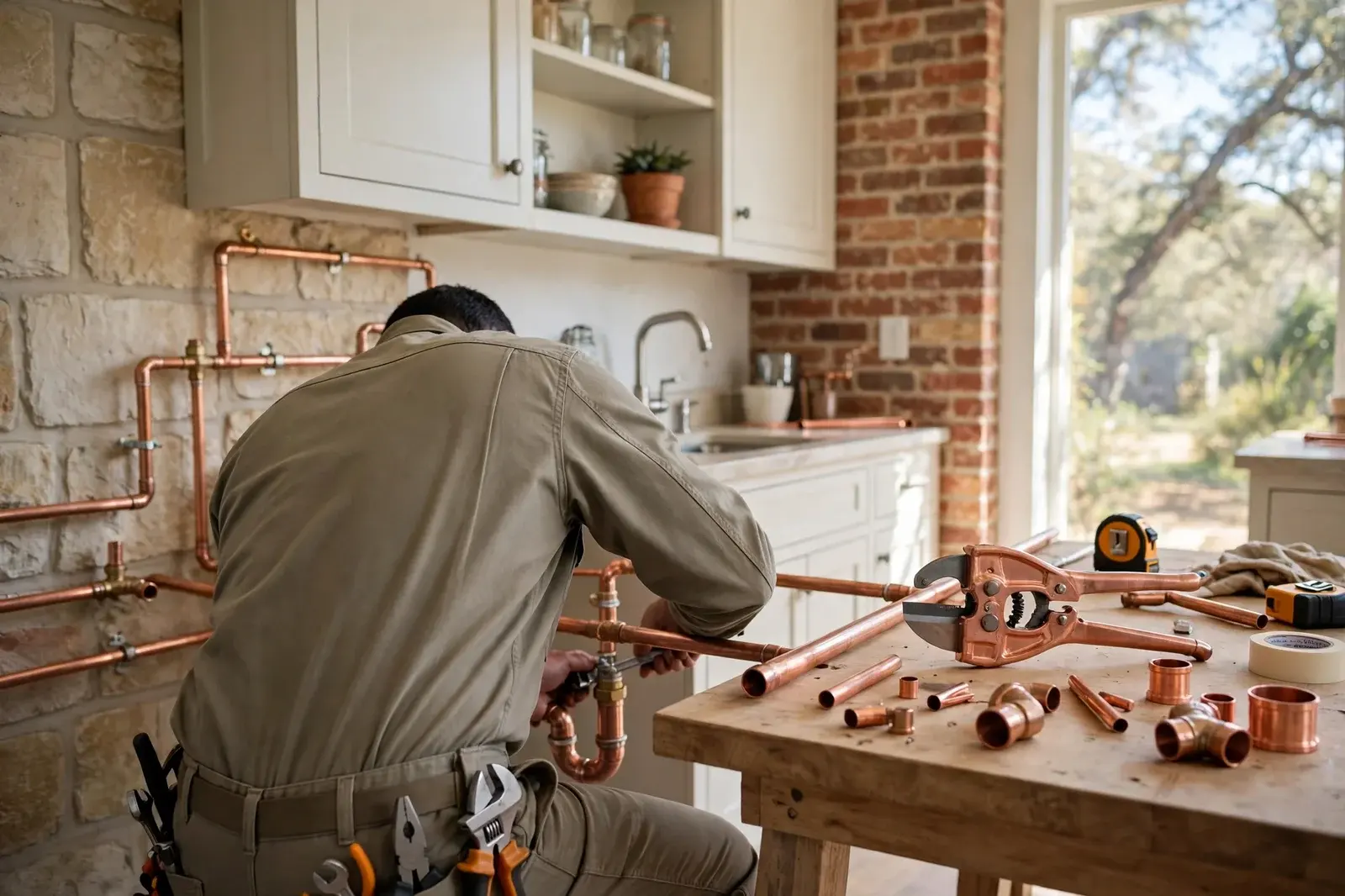
After the crew leaves a Austin home, the water is tested at every fixture, the walls are patched, and the site is cleaned. The homeowner should run every tap, flush every toilet and check the water heater before the crew signs off.
The other change is the paperwork. The permit, the inspection result, and the warranty go with the home's records, and they answer the first question a buyer or an insurer asks about the plumbing.
Keep them in the folder with the written quote.
New shutoff valves at each fixture make future repairs easy in Austin. A leak can be stopped at one tap instead of at the main.
Austin sits in Travis County, and the 75 ZIP codes covered here run from 73301 to 78799.
Repiping in Austin
Why waiting costs more in Austin
Pipes do not heal, and in Austin the older the system the faster the failures come. Galvanized pipe rusts from the inside, copper pits, and polybutylene can split with little warning.
The first leak is a warning; the second is a pattern.
Waiting also narrows the options. A repipe planned in advance is scheduled, quoted and done in a few days.
A repipe forced by a burst pipe is emergency work, with water damage to clean up first. The pipe does not get younger while the decision waits.
Homes in Austin with original galvanized or polybutylene pipe are on borrowed time. The inspection tells the homeowner how much time is left.
Austin has about 993,588 residents, and the repipe coverage here runs to 75 ZIP codes across Travis County.
In Austin, the work covers 75 ZIP codes, from 73301 to 78799. The home's county is Travis County, and the city population is about 993,588.
The local company serves the whole city, and the quote is based on the home, not the neighbourhood.
Repiping in Austin
Water hardness in Austin: what it does to pipes
Hard water leaves mineral scale inside pipes, and the scale narrows the bore year by year. In Austin, the effect shows up as weak pressure, slow-filling appliances, and white deposits on fixtures.
The inspection includes a look at the water. If the home's water is hard, PEX is often the better material, since it does not scale the way metal does.
The quote names the material, so the choice is the homeowner's.
White crust on fixtures is the visible sign of hard water, and the same mineral builds up inside the pipes unseen.
With about 993,588 residents, Austin is one of the larger cities in Texas where repiping is available, and the local company serves the whole city.
Repiping in Austin
Pinhole leaks and slab leaks in Austin
A slab leak in Austin is sometimes found by the floor, not by the meter. A warm spot on the floor, a tile that has lifted, or carpet that is damp in one place can all point to a leak under the concrete.
The crew confirms it with acoustic equipment and a pressure test before any floor is opened.
Many homeowners choose a re-route instead — a repipe that runs new lines through the attic or walls and abandons the slab lines entirely. It costs more than one patch, but it stops the repeat slab leaks that these homes often suffer.
A slab leak in Austin is sometimes found by the floor, not by the meter: a warm spot, a lifted tile, or damp carpet in one place.
The homes in Austin, Texas span 75 ZIP codes, and the local company confirms coverage by ZIP before booking.
Repiping in Austin
Rusty or brown water in Austin
Brown water in Austin is sometimes the water heater, not the pipes. Sediment builds up in the bottom of an old heater, and the first draw in the morning can run brown until the tank clears.
The test is to run the cold tap only: if the cold runs clear and the hot runs brown, the heater is the source.
If both hot and cold run brown after sitting overnight, the pipes are the source, and the rust is coming from galvanized steel. A repipe fixes the pipe side of the problem.
The heater side is fixed by flushing the tank or replacing the heater.
If the colour comes from the city supply, the neighbours see it too. A repipe fixes the home's side of the problem, and the water runs clear.
Repiping in Austin covers the whole city — about 993,588 residents and 75 ZIP codes in Travis County.
Repiping in Austin
Freeze risk for pipes in Austin
The first defence against a freeze in Austin is knowing where the main shutoff is. If a pipe splits, the water must be stopped at the main within minutes, and the shutoff is usually near where the water line enters the home.
New PEX lines reduce the risk, and insulation removes most of what is left. The inspection notes which runs are exposed, and the crew plans around them.
Insulating exposed runs is the second defence against a freeze, and the repipe is the time to do it while the walls are open.
Austin sits in Travis County, and the 75 ZIP codes covered here run from 73301 to 78799.
Repiping in Austin
PEX or copper: what fits Austin homes?
A Austin homeowner choosing pipe material should weigh three things: cost, life and water. PEX costs less, lasts about 40 to 50 years, and shrugs off hard water.
Copper costs more, lasts 50 to 70 years, and suits hot-water runs well.
The practical difference is price and time: PEX usually saves a few thousand dollars and a day of work. The durability difference is real but small over a normal stay in a home.
The quote should show both options so the choice is yours.
Whatever the material, the installation matters more: clean joints, proper supports, and a pressure test at the end. Ask the company how it tests its work.
With about 993,588 residents, Austin is one of the larger cities in Texas where repiping is available, and the local company serves the whole city.
Repiping in Austin
Your water utility and shutoff in Austin
During a repipe in Austin, the water is shut off at the main during working hours and restored each evening. The crew tells the household the shutoff plan each morning, so nobody is caught by surprise.
Knowing where the meter is matters, because the street shutoff in the meter box is the backup when the inside shutoff fails. The crew can show the homeowner both on the first visit.
A seized main shutoff is fixed during the repipe, and every fixture gets a new shutoff valve as part of the job.
Austin has about 993,588 residents, and the repipe coverage here runs to 75 ZIP codes across Travis County.
Repiping in Austin
Polybutylene pipes in Austin homes
Polybutylene was used in Austin homes built from the late 1970s to the mid-1990s, and the pipe is now old enough that its failure record is the whole story. The chlorine in treated water makes it brittle, and the fittings are the weak point.
A fitting can let go with no warning, and the water release is large.
Replacing it is a standard repipe, and the new pipe is usually PEX, which fits the same routes. The work takes a few days, the water is restored each evening, and the walls are patched after the inspection.
The grey plastic is out of service for good.
The chlorine in treated water makes polybutylene brittle over time, and the fittings are the weak point. A fitting can let go with no warning.
With about 993,588 residents, Austin is one of the larger cities in Texas where repiping is available, and the local company serves the whole city.
Repiping in Austin
What happens during a repipe in Austin?
A repipe crew in Austin does not start by opening walls at random. The first step is mapping: where the main enters, where the water heater sits, and how the lines reach the kitchen, bathrooms and laundry.
That map decides the access points and keeps the openings small.
Then the crew works room by room. Old lines are cut out or capped, new PEX or copper goes in, and the water is tested before the walls are closed.
An inspection usually follows the rough-in. The last step is patching, cleanup and a final pressure check.
Before the crew arrives, the homeowner clears access to every fixture the job touches. The crew confirms where it needs access on the first visit.
The homes in Austin, Texas span 75 ZIP codes, and the local company confirms coverage by ZIP before booking.
Repiping in Austin
Soil and ground movement under Austin homes
Ground movement shows up as a warm spot on the floor, a tile that has lifted, or carpet that is damp in one place. The crew in Austin confirms a slab leak with acoustic equipment and a pressure test before any floor is opened.
During a repipe in Austin, the new lines run above ground, through the attic or walls, so soil no longer touches them. The old buried lines are drained, capped, and left in place.
The lasting fix for a slab leak is a reroute through the attic or walls, with the old slab lines capped and left in place.
Austin has about 993,588 residents, and the repipe coverage here runs to 75 ZIP codes across Travis County.
Repiping in Austin
How long does a repipe take in Austin?
A repipe in Austin is measured in days, not weeks. The pipe work itself usually takes two to five days for a whole home.
The crew works room by room so the home stays usable, and the water is back on each evening.
Patching time depends on how many openings there were. A home with open access needs few patches; a home with finished walls needs more, and texture and paint add time.
The quote should show the full timeline, including patching, so the homeowner knows when the home is fully back to normal.
The crew in Austin plans around the inspection, and the walls stay open until the inspector signs off. That is the part of the timeline to expect.
With about 993,588 residents, Austin is one of the larger cities in Texas where repiping is available, and the local company serves the whole city.
Repiping in Austin
What does a repipe inspection find in Austin?
A repipe inspection starts with a pressure test. A gauge on the main shows what the supply delivers, and a gauge inside shows what the home keeps.
When the gap is large, the home's own pipes are eating the pressure. The test takes minutes and settles whether the pipes are the problem.
After the inspection, the homeowner has the map, the pressure readings, and the written quote. If the pipes test well, the crew will say so, and a repipe may not be needed at all.
The inspection is how the homeowner finds out which case it is, before spending anything.
The inspection is how the homeowner in Austin finds out whether the pipes can wait or not, before spending anything.
In Austin, about 993,588 people live across 75 ZIP codes in Travis County, and the local company covers all of them.
Repiping in Austin
How much does repiping cost in Austin?
Prices for repiping in Austin depend on the home more than the city. A two-bedroom home with a simple layout can repipe for $4,500 to $7,000 in PEX.
A four-bedroom home with three bathrooms, a laundry room and a long run to the kitchen can reach $10,000 to $12,000 in PEX, or $15,000 to $20,000 in copper.
Ask the local company to show the quote in writing with the material named, not just a price. PEX and copper should both be priced, so the choice is yours.
If the two prices are close, the dearer material may be worth it; if they are far apart, the cheaper one usually is.
Budget for the quote, not for the average. The average is a guide; the quote is the price for this home, in Austin, with its own pipes and layout.
The homes in Austin, Texas span 75 ZIP codes, and the local company confirms coverage by ZIP before booking.
Repiping in Austin
Galvanized pipe in older Austin homes
Galvanized pipe in Austin tells its age in the water bill as well as in the water. A bill that climbs with no new use can mean a hidden leak, and a galvanized system that is rusting through will leak somewhere, sooner or later.
The meter test finds it: shut off every fixture and watch the meter.
If the meter moves, water is going somewhere it should not. The crew then finds the leak by listening and by testing, and the fix is usually a replacement rather than a patch, because the rest of the system is the same age and the same material.
A magnet sticks to galvanized steel, and a scratch shows silver-grey metal. The crew in Austin can confirm the material in a single visit.
About 993,588 people live in Austin, and every one of the 75 covered ZIP codes is served from Travis County.
Repiping in Austin
Low water pressure in Austin: pipes or something else?
Pressure trouble in Austin is sometimes the regulator, not the pipes. The regulator sits near the main and sets the pressure for the whole home, and it can drift over the years.
A regulator set too low starves every tap, and the fix is a small adjustment or a replacement, not a repipe.
The regulator and valve are cheap checks. The pipes are the expensive one, but they are also the common one in homes with original galvanized lines.
A pressure test and a look at the pipe material settle it before any wall is opened.
If only one tap is weak in a Austin home, the cause is usually local — a clogged aerator or a single valve — and a repipe is not needed.
Repiping in Austin covers the whole city — about 993,588 residents and 75 ZIP codes in Travis County.
Repiping in Austin
Permits and inspections for repiping in Austin
Repiping is not a job to do without a permit in most cities. The permit covers the rough-in inspection, which happens after the new pipes are in and before the drywall goes back.
The inspector checks that the pipe is supported, the joints are sound and the system holds pressure.
If anything needs fixing, it is fixed while the walls are still open — which is the point of inspecting at that stage. The local company handles the scheduling, and the homeowner does not need to be present, though many choose to be.
The permit for a repipe in Austin is filed by the local company, and the homeowner's part is to confirm it is filed and keep the number.
Austin sits in Travis County, and the 75 ZIP codes covered here run from 73301 to 78799.
Signs you may need repiping
- Brown water in the morning is rust from the inside of old steel pipe
- A home inspector flagging old pipe material before a sale
- A rising water bill with no new use can mean a hidden leak
- A split pipe after a freeze is a sign the system is past its life
- A slab that feels warm in one spot, or flooring that is damp
- Sputtering taps can mean air entering through a failing pipe
- Aerators that keep clogging with rust flakes point to corroding pipe
- Knocking pipes can mean loose supports or pressure trouble in old lines
- A shutoff that will not turn is as old as the pipes it serves
- A metallic taste or smell in the water often comes from old pipe
How it works
- 1
Step 1 — Look before cutting
The crew tests the water pressure, finds the pipe material and maps the runs from the main to every fixture.
- 2
Step 2 — Confirm the scope
The local company quotes the job in writing — material, areas covered, patching and warranty — and files the plumbing permit.
- 3
Step 3 — Label the runs
Old lines are drained, capped, and left in the walls, since pulling them out would open far more wall.
- 4
Step 4 — Test and close up
The system is pressure-tested, the inspector checks the rough-in, and the walls are patched and cleaned up.
- 5
Step 5 — Drywall patching
Openings are patched, taped, and sanded. The quote says whether texture and paint are included.
- 6
Step 6 — Final walkthrough and paperwork
The final walkthrough covers every tap and toilet, and the permit, inspection result, and warranty are left with the homeowner.
Repiping cost in Austin
What does it cost?
Prices vary by home size, pipe material and access. The ranges below are typical national figures, shown as estimates only — the local company's written quote is the real price.
| Service | Typical range (estimate) | Notes |
|---|---|---|
| Whole-home repipe (PEX) | $4,500 – $12,000 | Most 2–3 bed homes |
| Whole-home repipe (copper) | $8,000 – $20,000 | Longer-lasting metal pipe |
| Partial repipe (one area) | $2,000 – $6,000 | One bathroom or hot lines |
| Polybutylene replacement | $5,000 – $15,000 | Full grey-pipe swap |
| Galvanized pipe replacement | $5,000 – $15,000 | Old steel out, new pipe in |
| Pressure test & pipe inspection | $150 – $400 | Standalone visit |
Prices are estimates only. The local company that does the work sets its own final pricing.
Questions about repiping in Austin