
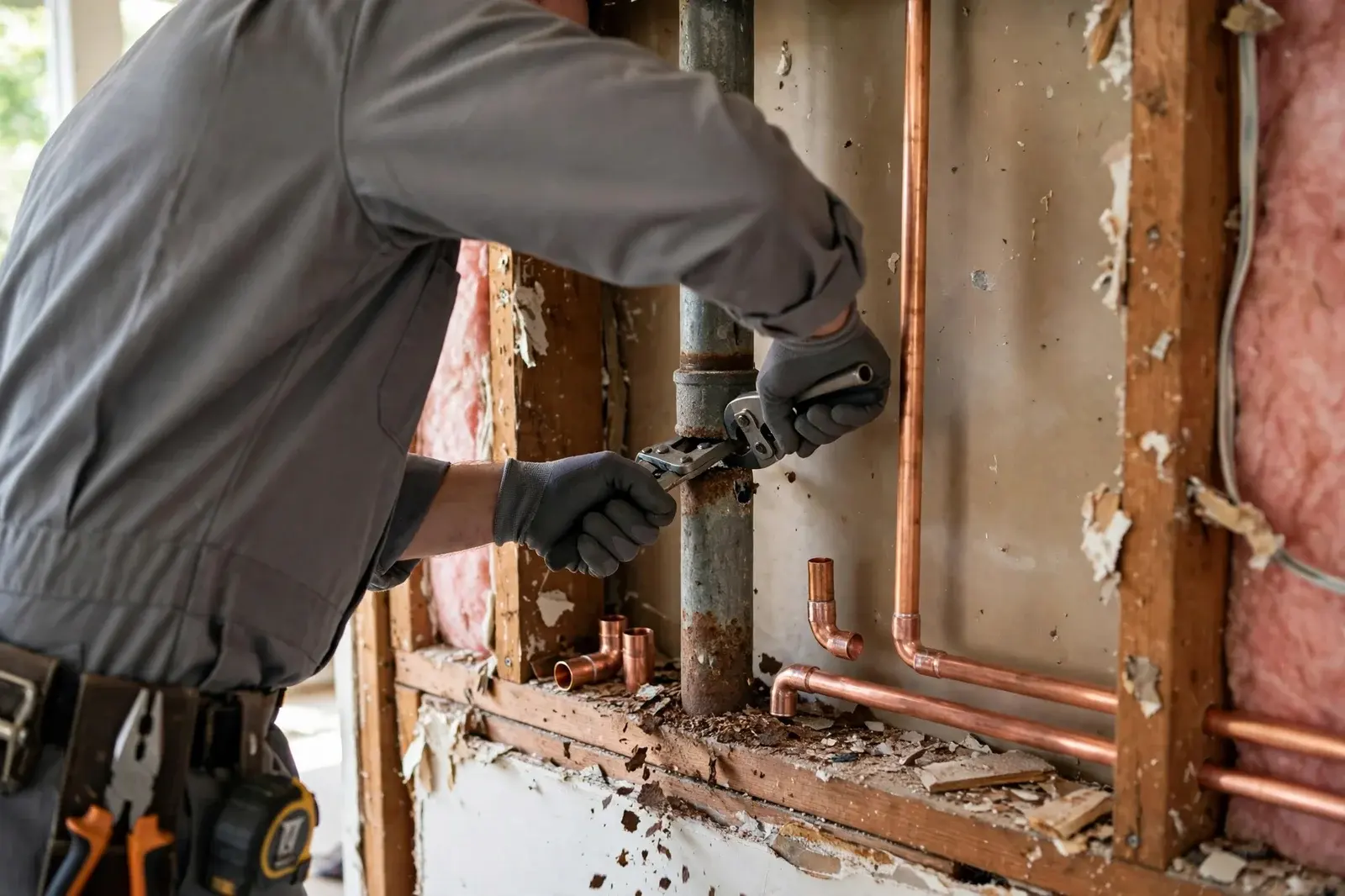
Galvanized Pipe Replacement Services
When the pipes in a home keep leaking, lose pressure, or turn the water brown, Galvanized Pipe Replacement replaces them with new PEX or copper lines. A local plumbing company inspects first, then gives a written quote. The crew works room by room and pressure-tests the new lines before the walls close. Call (833) 878-1592 to book an inspection.
Updated 2026-11-18. Prices shown are estimates only.
- $150–$20,000 Typical cost range
- 6 Steps in the visit
- 12 Questions answered
Before & after — galvanized pipe replacement
Before & after
Drag the slider to compare the same spot before and after the repair.
Galvanized Pipe Replacement
What is galvanized pipe, and why replace it?
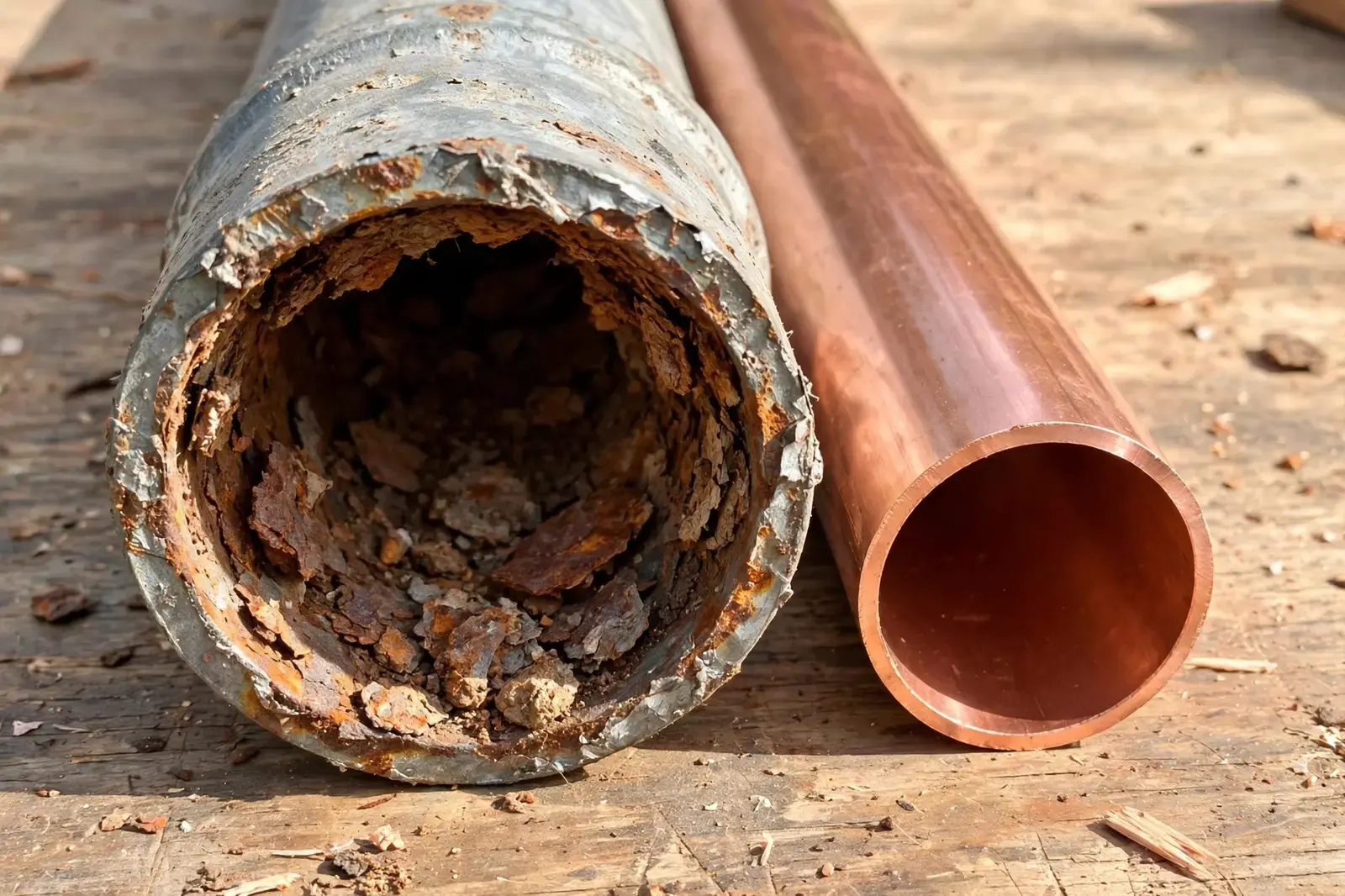
Galvanized pipe is steel pipe coated with zinc, used in most homes built before the 1970s. The zinc wears away, the steel rusts, and the inside of the pipe narrows year by year until pressure drops and water turns brown.
It is dull grey, magnetic, and joined with threaded fittings. A magnet sticks to it, and a scratch shows silver-grey metal.
Galvanized pipe has a working life of roughly 40 to 60 years, and most of it is past that now. The narrowing is why it cannot be fixed by cleaning: the pipe wall itself is the problem.
Replacement with PEX or copper restores full flow and clear water, and it ends the leak cycle at the threaded joints.
Galvanized replacement is usually done in PEX or copper, and the quote should show both prices. PEX is cheaper and faster; copper lasts longer and handles heat better.
Galvanized pipe is dull grey steel, magnetic, and joined with threaded fittings. A magnet sticks to it, and a scratch shows silver-grey metal.
Homeowners sometimes ask whether a galvanized replacement can wait until next year. The honest answer is that it can, if the pipes are not leaking and the pressure holds — but the inspection is what decides, and waiting is a guess without it.
Galvanized Pipe Replacement
How much does galvanized pipe replacement cost?
Replacing galvanized pipe usually runs $5,000 to $15,000 for a whole home, depending on size, fixture count, and access. In PEX, a whole-home repipe usually lands between $4,500 and $12,000.
In copper, the same home runs $8,000 to $20,000. A partial replacement — the worst sections only — usually runs $2,000 to $6,000.
These are typical national ranges, shown as estimates only. The written quote follows the inspection and should list the material, the areas covered, the permit, the inspection, and the patching.
Homes with a slab foundation, where pipes are rerouted through the attic, tend toward the higher end, because the new routes are longer.
The written quote for a galvanized replacement follows the inspection and reflects the home, not the average. Ask what the quote includes, including the permit, the inspection, and the patching.
The zinc coating on galvanized pipe wears away, the steel rusts, and the inside narrows until the pressure drops and the water turns brown. Cleaning does not restore it.
The quote for a galvanized replacement is only useful if it can be compared. Two quotes with the same material, the same rooms, and the same inclusions can be compared; two quotes that list different things cannot.
Galvanized Pipe Replacement
Signs a galvanized system is finished
The signs are familiar. Weak pressure at every tap at once, brown water first thing in the morning, and rust flakes clogging the tap aerators again and again.
A washing machine that fills slowly with clean filters. Hot water that runs out faster than it used to, because the hot lines have scaled and narrowed most.
The other sign is the pipe itself. Cut out a section and look inside: a healthy pipe has a clean bore, while a galvanized pipe at the end of its life is choked with rust, sometimes down to a pencil-wide opening.
The local company can show a cut-out section during the inspection, so the decision is based on what the pipe actually looks like.
For a home with galvanized pipe, replacement is the lasting fix. The pipe wall is rusted and thin, and cleaning does not restore it.
Replacing galvanized pipe is usually done in PEX or copper, and the quote should show both prices. PEX is cheaper and faster; copper lasts longer.
PEX and copper both pass inspection for a galvanized replacement, and both last decades. The choice is about the home: its water, its layout, and what the homeowner is willing to pay.
Galvanized Pipe Replacement
What replaces galvanized pipe?

PEX is the usual replacement. It costs less, installs faster, and its smooth walls do not collect scale, so the pressure stays up.
A PEX repipe usually finishes a day sooner than copper, and it flexes when water freezes. Copper is the longer-life option at 50 to 70 years, and it suits homeowners who want metal pipe and are willing to pay for it.
Either way, the new pipe is a large step up from galvanized steel. The crew also fits new shutoff valves at each fixture and usually fits a new main shutoff, since the old one is as old as the pipes.
The water runs clear from the first glass, and the pressure usually improves at the same time.
The galvanized crew works to the plan the inspection produced. The permit is filed, the inspection is booked, and the water is restored each evening through the job.
A galvanized replacement takes two to five days for most homes, plus a day or two for patching. The water is off only during working hours.
The galvanized crew should leave the home tidy each evening. Floors protected, debris removed, and the water back on.
A company that leaves a mess leaves a clue about the rest of the job.
Galvanized Pipe Replacement
How is galvanized pipe replaced?
The crew maps the system first, then replaces the lines in sections, testing as it goes. Old galvanized lines are heavy and threaded, so they are cut out in pieces rather than pulled.
The new PEX or copper runs beside them or through new routes, often through the attic in homes where the old pipes ran under the slab.
The old steel is capped and left in the walls, since removing it would mean opening far more wall. The work takes two to five days for most homes, with water off only during working hours.
The system is pressure-tested, the inspector checks the rough-in, and the walls are patched. The crew removes the cut-out sections and any debris at the end of the job.
Patching after a galvanized replacement is sometimes a separate item, and it is better to know that before work starts than after. Ask exactly what the patching covers.
The old galvanized pipe is capped and left in the walls, or removed where it is easy to reach. The new PEX or copper runs through the same routes.
Patching after a galvanized replacement is the part homeowners notice most, because it is what they see. Ask who patches, how many coats, and whether texture and paint are included before the job starts.
Galvanized Pipe Replacement
Will new pipes fix the brown water?
Yes, when the colour comes from the home's own pipes. Rust flakes off the inside of galvanized steel while the water sits, then flushes out when the tap opens.
That pattern — brown first thing in the morning, clearing after a minute of running — is the classic sign of a galvanized system at the end of its life. New PEX or copper has nothing to rust, so the water runs clear.
If the colour comes from the city supply, the neighbours see it too, and it does not clear with running. A repipe will not fix that.
The test is simple: run the cold tap for a minute. If it clears, the rust is in the home's pipes.
If it stays brown, call the water utility. The inspection sorts this out before any work is quoted.
A pressure test is part of the galvanized inspection, and it separates the causes in minutes. Good pressure at the main with weak pressure at the taps means the pipes are the problem.
Once the replacement is done, the water should run clear and strong from the first evening. If it does not, the company should be called back before the walls are patched.
A galvanized replacement is a big job, and it deserves a written quote. The inspection produces it, the homeowner reads it, and the work starts only when it is agreed.
Galvanized Pipe Replacement
Galvanized replacement and your water heater
A galvanized replacement connects to the water heater with new pipe, and the heater is drained and reconnected as part of the job. The old galvanized runs to the heater are usually the worst in the home, because hot water speeds the rust.
The replacement is a good time to look at the heater's age. If it is near the end of its life, replacing it during the same visit saves a second call-out and a second drain-down.
The crew flushes the heater after the new lines are in, checks the pressure relief valve, and the first hot water should run clear.
Galvanized Pipe Replacement
How Galvanized Pipe Replacement works, step by step
Galvanized Pipe Replacement follows the same steps whatever the home. First the crew inspects: a pressure test, a look at the pipe material, and a map of the runs from the main to every fixture.
That map becomes the plan, and the plan becomes the written quote.
Then the crew replaces the lines, room by room, fitting new shutoff valves at each fixture and capping the old lines. The system is pressure-tested, the inspector checks the rough-in, and the walls are patched.
The water is off only during working hours.
Galvanized Pipe Replacement
Galvanized Pipe Replacement cost breakdown: where the money goes
The material is the most visible cost of Galvanized Pipe Replacement, and it is the part the homeowner chooses: PEX or copper, and the fittings that go with it. The labour is the larger part, and it follows the home — more fixtures, more walls, more days.
The permit and the patching are the parts people forget to ask about. The permit is filed with the city, the inspection follows the rough-in, and the patching closes the walls.
All three belong on the quote.
Galvanized Pipe Replacement
Galvanized Pipe Replacement or a repair: when replacement wins
Patching is cheaper today and dearer over time when the system is failing. Each patch fixes one spot and leaves the rest of the old pipe in the wall, ageing at the same rate.
Galvanized Pipe Replacement costs more once and ends the cycle: new lines, new valves, and a system that should last decades. For a home where the pipes are the problem, replacement is usually the cheaper path within a few years, and it is the only path that fixes the pressure and the water at the same time.
Galvanized Pipe Replacement
What to expect during Galvanized Pipe Replacement
During Galvanized Pipe Replacement, the home stays liveable. The crew works room by room, seals off the work rooms from dust, and cleans up each day.
The water is off during working hours and restored each evening, so the household's routine bends rather than breaks.
There is noise — cutting, drilling, and the occasional knock — and there are open walls for a few days. The crew checks in each morning with the plan for the day, so the homeowner knows when the water will be off and when it will be back.
Galvanized Pipe Replacement
After Galvanized Pipe Replacement: care, warranty, and records
After Galvanized Pipe Replacement, the water should run clear and strong from the first evening, and the pressure should hold at every tap. If it does not, the company should be called back — the pressure test and the walkthrough are meant to catch that before the crew leaves.
The warranty covers the work and the material, and the permit and inspection result prove the job was done to code. Keep all three with the home's records, and the repipe is an asset at sale time, not a question.
Galvanized Pipe Replacement
Galvanized Pipe Replacement and your home's value
The value of Galvanized Pipe Replacement at sale time is the paperwork: the permit, the inspection result, and the warranty, kept with the home's records. A buyer sees new pipes and a clean inspection, and the plumbing leaves the negotiation.
Without it, the buyer sees old galvanized or polybutylene pipe and asks for a credit that is usually larger than the cost of the repipe itself. Doing the job before listing takes that demand off the table.
Galvanized Pipe Replacement
Where Galvanized Pipe Replacement is available
The Galvanized Pipe Replacement service area covers the cities listed on this site, and the coverage is confirmed by ZIP code before booking. The largest cities have the most appointments, and the smaller towns are served on the same schedule.
Whatever the city, the work is the same: new lines, new valves, a pressure test, an inspection, and patching. The local company serves the whole area, and the quote comes after the inspection in every place.
Galvanized Pipe Replacement
Galvanized Pipe Replacement and the other repipe services
The six services on this site are parts of one job, not six different jobs. Whole-home repiping is the full replacement.
PEX and copper are the two materials it uses. Polybutylene and galvanized replacement are the same job aimed at one pipe material.
A partial repipe is the same job on part of the home. The inspection maps the system and says which service fits, and the written quote lists it by name.
The homeowner does not need to choose in advance — the inspection chooses.
Galvanized Pipe Replacement
Reading the signs: what they mean for Galvanized Pipe Replacement
These are the signs a homeowner can check without opening a wall. If several of them match, the pipes are the story, and the inspection confirms it.
The older the home, the more likely several signs appear at once, and that is when Galvanized Pipe Replacement stops being a maybe. The crew tests the pressure and looks at the pipe material on the first visit.
Galvanized Pipe Replacement
Questions to ask before Galvanized Pipe Replacement
Five questions cover Galvanized Pipe Replacement before it starts: the material, the scope, the permit, the patching, and the warranty. The company should answer each one and put the answers in writing.
Ask also about the crew: who is coming, how many days, and what the shutoff plan is each day. A company with a clear plan will say so, and the homeowner will know what to expect.
Galvanized Pipe Replacement
How Galvanized Pipe Replacement is inspected
The inspection is scheduled after the new lines are in and before the patching starts. The inspector looks at the pipe material, the joints, the supports, and the valve at each fixture.
The pressure test runs at the same visit, and the system must hold pressure with no drop. The inspection result is the proof the job was done to code, and it belongs with the home's records.
Galvanized Pipe Replacement
Galvanized Pipe Replacement in older homes
Old homes hide their pipes well, and Galvanized Pipe Replacement starts with finding them. The crew traces the runs from the meter to each fixture, tests the pressure, and looks at the pipe material where it shows.
The quote for an older home should name the material, the rooms, the permit, and the patching, and it should say what happens if the crew finds more old pipe than expected. A good company plans for that.
Galvanized Pipe Replacement
The materials used in Galvanized Pipe Replacement
Two materials do most of the work in Galvanized Pipe Replacement: PEX and copper. PEX is flexible, fast, and cheap, and it resists freeze damage.
Copper is rigid, long-lived, and the standard for exposed runs.
The quote should name which material is used where, and the fittings that go with it. A home can mix the two, with PEX for long hidden runs and copper where the pipe shows.
Galvanized Pipe Replacement
Timing your Galvanized Pipe Replacement
The best time for Galvanized Pipe Replacement is before the pipes fail, and the inspection is how the homeowner knows when that is. A planned job costs less than an emergency one, and it can be booked when the household is ready.
Lead times run a few weeks in busy seasons, so the inspection should be booked early. The job itself takes a few days, and the water is restored each evening.
Signs you may need galvanized pipe replacement
- Brown water first thing in the morning
- Weak pressure at every tap at once
- Rust flakes clogging tap aerators again and again
- Dull grey magnetic pipe with threaded joints
- A home built before 1970 with its original pipes
- A washing machine that fills slowly with clean filters
- A water bill that climbs with no new use in the home
- Damp patches on a wall or ceiling with no fixture above
- Hot water running out sooner than it used to
- Pipes knocking or groaning when a tap opens
How it works
- 1
Step 1 — Inspect the old steel
The crew checks the bore of a cut-out section, tests the pressure and maps the runs.
- 2
Step 2 — Quote and permit
The written quote lists the replacement material, the areas covered and the patching. The company files the permit.
- 3
Step 3 — Cut out the steel
Old galvanized lengths are cut out in pieces. New PEX or copper runs beside them or through new routes.
- 4
Step 4 — Test, inspect and patch
The system is pressure-tested, the rough-in is inspected, and the walls are patched.
- 5
Step 5 — Patch and finish
The crew patches every opening, sands it smooth, and leaves the walls ready for texture and paint.
- 6
Step 6 — Walkthrough and records
The homeowner runs every fixture with the crew, and the permit number, inspection result, and warranty are left with the home's records.
Galvanized Pipe Replacement cost
What does it cost?
All figures are typical national ranges, shown as estimates only. The written quote from the local company replaces them once the pipes have been inspected.
| Service | Typical range (estimate) | Notes |
|---|---|---|
| Full galvanized replacement (PEX) | $5,000 – $12,000 | Most homes |
| Full galvanized replacement (copper) | $8,000 – $20,000 | Metal pipe option |
| Partial galvanized replacement | $2,000 – $6,000 | Worst sections only |
| Galvanized joint repair (single) | $300 – $800 | One joint, not a system fix |
| Slab reroute (attic lines) | $6,000 – $15,000 | Lines out of the slab |
| Pressure test & pipe inspection | $150 – $400 | Standalone visit |
Prices are estimates only. The local company that does the work sets its own final pricing.
Questions about galvanized pipe replacement