
PEX Repiping Services
PEX Repiping is a full replacement of the home's water supply pipes — the lines that carry water to every tap, toilet, and shower. Whole-home repiping with flexible PEX pipe. The work is done by a local plumbing company over a few days, with the water restored each evening. Call (833) 878-1592 for a written quote after an inspection.
Updated 2026-11-18. Prices shown are estimates only.
- $150–$12,000 Typical cost range
- 6 Steps in the visit
- 12 Questions answered
Before & after — pex repiping
Before & after
Drag the slider to compare the same spot before and after the repair.
PEX Repiping
What is PEX repiping?
PEX repiping replaces a home's old water supply pipes with cross-linked polyethylene pipe, known as PEX. It is flexible plastic pipe that bends around corners, which means fewer joints and fewer places for a leak to start.
The pipe comes in coils, threads through walls with fewer openings, and connects with crimp or expansion fittings rather than solder. It is the most common material for a whole-home repipe today.
PEX is made for drinking water and carries the NSF/ANSI 61 certification, which limits what can leach into the water. It does not corrode, it does not build up scale on its smooth walls, and it flexes when water freezes instead of splitting.
A PEX system is rated for about 40 to 50 years in normal use, and the installer states the warranty it offers on the work.
PEX is flexible plastic pipe that bends around corners, which means fewer joints and fewer places for a leak to start. It comes in coils, threads through walls with fewer openings, and connects with crimp or expansion fittings.
PEX is the most common material for a whole-home repipe today, and the installer states the warranty it offers on the work. The pipe is rated for about 40 to 50 years in normal use.
The flexibility of PEX is what makes the job faster. Long runs thread through walls and the attic without a joint at every turn, and that is where the saving comes from.
PEX Repiping
How much does a PEX repipe cost?

A PEX repipe usually runs $4,500 to $12,000 for a whole home. A two-bedroom home with a simple layout can repipe for $4,500 to $7,000.
A four-bedroom home with three bathrooms, a laundry room, and a long run to the kitchen can reach $10,000 to $12,000. A partial PEX repipe — one bathroom group or the hot-water lines only — usually runs $2,000 to $6,000.
PEX costs less than copper for two reasons: the material is cheaper, and the install is faster. Fewer joints and flexible runs mean the crew finishes about a day sooner than the same job in copper.
These are typical national ranges, shown as estimates only. The written quote follows the inspection and reflects the home, not the average.
Ask what the quote includes, including the permit, the inspection, and the patching.
The material is cheaper and the install is faster, and those two facts are why PEX usually costs less than copper for the same home. The written quote follows the inspection and reflects the home, not the average.
The written quote follows the inspection and reflects the home, not the average. Ask what the quote includes, including the permit, the inspection, and the patching.
Ask the installer which PEX system it uses — PEX-A with expansion fittings or PEX-B with crimp rings — and make sure the quote names it. The pipe should be marked for hot and cold use.
PEX Repiping
Why do so many repipes use PEX?
Speed and price are the plain reasons. PEX threads through walls in long runs, so the crew opens fewer holes and finishes sooner.
Fewer joints mean fewer leak points over the life of the system. The pipe resists freeze damage by flexing, and its smooth bore stays clear in hard water where metal pipe scales up.
For a family that wants the job done in a few days with the walls patched and the water clear, PEX is a practical pick.
There are limits worth knowing. PEX should not sit in direct sunlight for long, so it is an indoor pipe.
It is not used for the short run right at a gas water heater's flue in some codes, where metal is needed. Some people notice a slight taste in the water for the first days after install; running the taps clears it.
The installer can say which brand and fitting system it uses and what warranty covers it.
PEX resists freeze damage by flexing, and its smooth bore stays clear in hard water where metal pipe scales up. For a family that wants the job done in a few days with the walls patched and the water clear, it is a practical pick.
For a family that wants the job done in a few days with the walls patched and the water clear, PEX is a practical pick. It resists freeze damage by flexing and stays clear in hard water.
PEX resists the mineral scale that chokes old steel pipe, and it does not rust. In hard-water homes, that is a real advantage over galvanized pipe.
PEX Repiping
How is a PEX repipe installed?
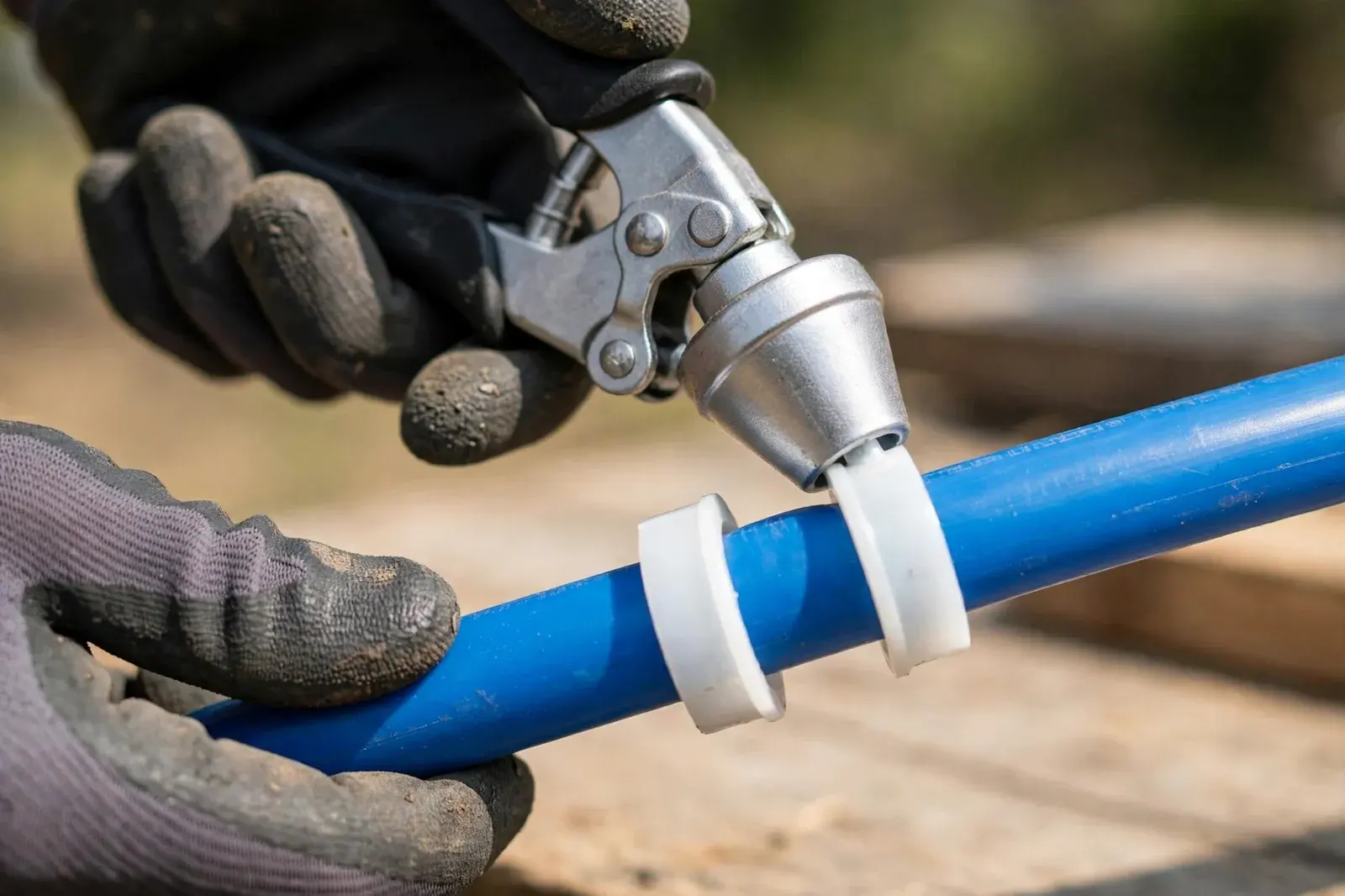
The crew starts by mapping the system: where the main enters, where the water heater sits, and how the lines reach the kitchen, bathrooms, and laundry. PEX runs are planned to use the pipe's flexibility, threading through walls and the attic with as few openings as possible.
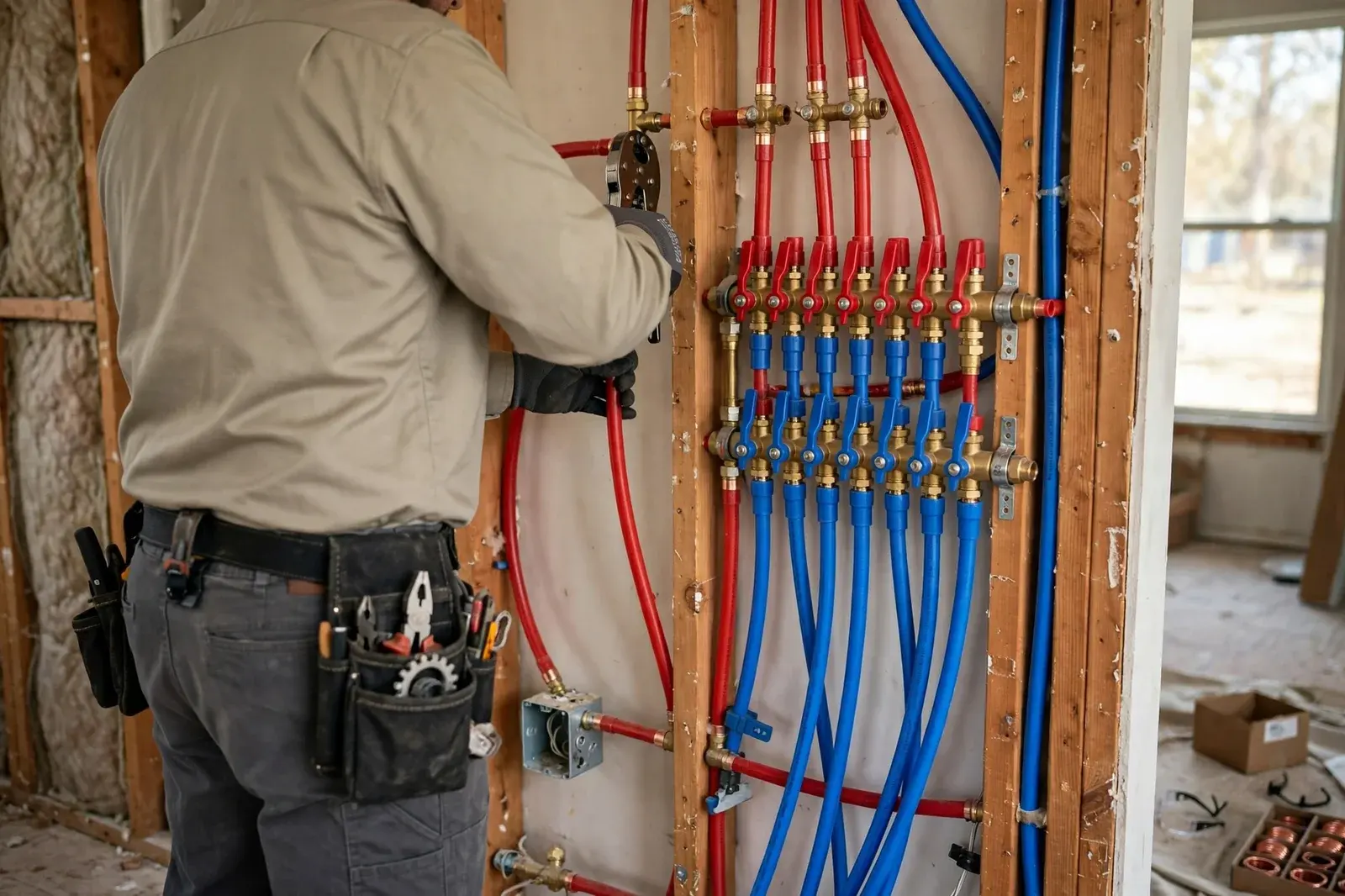
A manifold is often fitted near the main, giving each fixture its own home run and its own shutoff.
During the install, the crew cuts the old lines out of service, runs the new PEX, and joins it with crimp rings or expansion fittings, depending on the pipe type. Each fixture gets a new shutoff valve.
The system is pressure-tested, the inspector checks the rough-in, and the walls are patched. Most homes finish the pipe work in two to four days, a day sooner than copper.
A manifold near the main gives each fixture its own home run and its own shutoff, which makes future repairs easy. The crew plans the PEX runs to use the pipe's flexibility, threading through walls and the attic.
A manifold near the main gives each fixture its own home run and its own shutoff. The crew plans the PEX runs to use the pipe's flexibility, threading through walls and the attic.
The crew should leave the home tidy each evening, with the water back on and the debris removed. A company that leaves a mess leaves a clue about the rest of the job.
PEX Repiping
PEX vs copper: what changes for the homeowner?
The day-to-day difference is small. Water runs clear and strong either way, and both materials are approved for drinking water.
PEX is quieter: it does not tick or knock as it expands with hot water the way copper can. It also handles freezing weather better, since it flexes instead of splitting when water inside it freezes.
The difference that matters is price and time. A PEX repipe usually saves a few thousand dollars and a day of work against the same job in copper.
Copper lasts longer on paper — 50 to 70 years against PEX at 40 to 50 — but over a normal stay in a home, that gap rarely decides anything. The quote should show both options so the choice is the homeowner's, not the sales pitch's.
The day-to-day difference between PEX and copper is small: water runs clear and strong either way. PEX is quieter, since it does not tick or knock as it expands with hot water the way copper can.
The quote should show both options so the choice is the homeowner's, not the sales pitch's. PEX usually saves a few thousand dollars and a day of work against the same job in copper.
A PEX repipe is usually the cheapest way to replace a whole system, and the quote should show both PEX and copper prices so the choice is the homeowner's.
PEX Repiping
Is PEX safe for drinking water?
PEX pipe made for drinking water is certified to NSF/ANSI 61, which sets limits on what can leach into water. It is used in millions of US homes, in new builds as well as repipes.
The certification is the thing to check: ask the installer which brand it uses and confirm the pipe is marked for potable water.
A few practical notes: PEX should be kept out of prolonged sunlight, and it is not the pipe for the exposed run at a water heater vent. In the first days after install, some people notice a slight plastic taste; flushing the taps for a few minutes clears it.
After that, the water should taste the same as before, and the pipe itself needs little attention for decades.
PEX pipe made for drinking water is certified to NSF/ANSI 61, which sets limits on what can leach into water. Ask the installer which brand it uses and confirm the pipe is marked for potable water.
PEX should be kept out of prolonged sunlight, and it is not the pipe for the exposed run at a water heater vent. After install, the water should taste the same as before.
Once the PEX is in, the water should run clear and strong from the first evening. If it does not, the company should be called back before the walls are patched.
PEX Repiping
PEX repiping and your water heater
A PEX repipe connects to the water heater with a short stub of copper or CPVC, because the code requires a metal or rigid run near the vent. The heater is drained and reconnected as part of the job, and the crew checks the pressure relief valve while it is open.
The repipe is a good time to look at the heater's age. If it is near the end of its life, replacing it during the same visit saves a second call-out and a second drain-down.
A tankless heater pairs well with a PEX manifold, giving each fixture its own run and its own shutoff. The crew flushes the heater after the new lines are in, and the first hot water should run clear.
PEX Repiping
How PEX Repiping works, step by step
The first step of PEX Repiping is the inspection, and it is the step that decides everything else. The pressure test shows whether the pipes are the problem.
The pipe material shows how much life is left. The map shows which walls open.
After that, the work is straightforward: replace the lines, fit new valves, test the system, and patch the walls. The crew works to the plan the inspection produced, and the homeowner knows the price before any of it starts.
PEX Repiping
PEX Repiping cost breakdown: where the money goes
Most of the cost of PEX Repiping is labour: the crew's days on site, opening walls, running lines, and patching. The material is the smaller part for PEX and a larger part for copper.
The permit, the inspection, and the patching are fixed costs on top. They do not change much with the home, but they must be listed.
Ask for the quote in writing with each part shown, so the comparison with another quote is honest.
PEX Repiping
PEX Repiping or a repair: when replacement wins
A single leak is a repair, and the crew will say so. A pattern of leaks is a system, and the crew will say that too.
The difference is the pipe material and the leak history, and both are visible on the inspection.
PEX Repiping is the answer when the pattern points to the system. The quote should show both options — the repair and the replacement — so the homeowner can see the trade-off instead of being sold one of them.
PEX Repiping
What to expect during PEX Repiping
The disruption of PEX Repiping is real but short. A few days of cutting and patching, water off during working hours, and the crew in and out of the rooms where the pipes run.
What makes it bearable is the plan: the crew says each morning what will happen that day, the water is restored each evening, and the rooms are cleaned before the crew leaves. Most families stay in the home through the whole job.
PEX Repiping
After PEX Repiping: care, warranty, and records
After PEX Repiping, the water should run clear and strong from the first evening, and the pressure should hold at every tap. If it does not, the company should be called back — the pressure test and the walkthrough are meant to catch that before the crew leaves.
The warranty covers the work and the material, and the permit and inspection result prove the job was done to code. Keep all three with the home's records, and the repipe is an asset at sale time, not a question.
PEX Repiping
PEX Repiping and your home's value
The value of PEX Repiping at sale time is the paperwork: the permit, the inspection result, and the warranty, kept with the home's records. A buyer sees new pipes and a clean inspection, and the plumbing leaves the negotiation.
Without it, the buyer sees old galvanized or polybutylene pipe and asks for a credit that is usually larger than the cost of the repipe itself. Doing the job before listing takes that demand off the table.
PEX Repiping
Where PEX Repiping is available
The PEX Repiping service area covers the cities listed on this site, and the coverage is confirmed by ZIP code before booking. The largest cities have the most appointments, and the smaller towns are served on the same schedule.
Whatever the city, the work is the same: new lines, new valves, a pressure test, an inspection, and patching. The local company serves the whole area, and the quote comes after the inspection in every place.
PEX Repiping
PEX Repiping and the other repipe services
The six services on this site are parts of one job, not six different jobs. Whole-home repiping is the full replacement.
PEX and copper are the two materials it uses. Polybutylene and galvanized replacement are the same job aimed at one pipe material.
A partial repipe is the same job on part of the home. The inspection maps the system and says which service fits, and the written quote lists it by name.
The homeowner does not need to choose in advance — the inspection chooses.
PEX Repiping
Reading the signs: what they mean for PEX Repiping
The signs on this page are the ones that show up most often, and they are worth reading together. One sign on its own can be a small repair; several together usually mean the system is failing.
A home with two or three of these is worth an inspection, because the cost of finding out is small next to the cost of a burst pipe. The inspection is how the homeowner finds out which case it is.
PEX Repiping
Questions to ask before PEX Repiping
Ask what the quote includes before agreeing to PEX Repiping. The material, the rooms covered, the permit, the inspection, the patching, and the warranty should all be listed.
Ask how long the job takes and when the water is back on each day. Ask what happens if the inspector finds a problem.
The answers should be plain, and they should be in writing before any wall is opened.
PEX Repiping
How PEX Repiping is inspected
Every PEX Repiping job is inspected, and the inspection is the part that protects the homeowner. The inspector is from the city or county, not the company, and the permit number is the record of it.
If the inspector finds a problem, the crew fixes it and the inspection is repeated. The walls are not closed until the inspection passes, and the permit number goes to the homeowner with the warranty.
PEX Repiping
PEX Repiping in older homes
A home built before 1970 usually has galvanized steel pipe, and a home built in the 1980s may have polybutylene. Both are past their life, and PEX Repiping replaces them with PEX or copper.
Old homes also have surprises: pipes buried in plaster, runs through the slab, and shutoff valves that have not turned in decades. The inspection finds them before the work starts, and the quote should allow for them.
PEX Repiping
The materials used in PEX Repiping
Two materials do most of the work in PEX Repiping: PEX and copper. PEX is flexible, fast, and cheap, and it resists freeze damage.
Copper is rigid, long-lived, and the standard for exposed runs.
The quote should name which material is used where, and the fittings that go with it. A home can mix the two, with PEX for long hidden runs and copper where the pipe shows.
PEX Repiping
Timing your PEX Repiping
Book PEX Repiping when the signs say the system is failing, not when the ceiling says it has. The inspection takes one visit, and the quote follows it.
The work is usually booked a few weeks out, and the crew gives a schedule before it starts. The water is off during working hours and back on each evening, so the household's routine bends rather than breaks.
Signs you may need pex repiping
- Brown water and weak pressure from old steel pipe
- Grey polybutylene pipe near the water heater
- Repeat leaks on the same old line
- A slab leak that keeps coming back
- Pipes that freeze and split in cold weather
- A home inspector flagging old pipe material before a sale
- A water bill that climbs with no new use in the home
- Damp patches on a wall or ceiling with no fixture above
- Hot water running out sooner than it used to
- Pipes knocking or groaning when a tap opens
How it works
- 1
Step 1 — Map the system
The crew tests the pressure, identifies the old pipe material and plans the PEX runs, often with a manifold near the main.
- 2
Step 2 — Quote and permit
The written quote lists the material, the areas covered and the patching. The company files the permit.
- 3
Step 3 — Run the PEX
Flexible PEX threads through walls with fewer openings, joined with crimp or expansion fittings.
- 4
Step 4 — Test and patch
The system is pressure-tested, the rough-in is inspected, and the walls are patched.
- 5
Step 5 — Patch and finish
The crew patches every opening, sands it smooth, and leaves the walls ready for texture and paint.
- 6
Step 6 — Walkthrough and records
The homeowner runs every fixture with the crew, and the permit number, inspection result, and warranty are left with the home's records.
PEX Repiping cost
What does it cost?
All figures are typical national ranges, shown as estimates only. The written quote from the local company replaces them once the pipes have been inspected.
| Service | Typical range (estimate) | Notes |
|---|---|---|
| Whole-home PEX repipe | $4,500 – $12,000 | Most 2–3 bed homes |
| Partial PEX repipe (one area) | $2,000 – $6,000 | One bathroom or hot lines |
| PEX manifold install | $800 – $2,000 | Home-run system with shutoffs |
| Polybutylene to PEX swap | $5,000 – $12,000 | Full grey-pipe replacement |
| Galvanized to PEX swap | $5,000 – $12,000 | Old steel out, PEX in |
| Pressure test & pipe inspection | $150 – $400 | Standalone visit |
Prices are estimates only. The local company that does the work sets its own final pricing.
Questions about pex repiping