
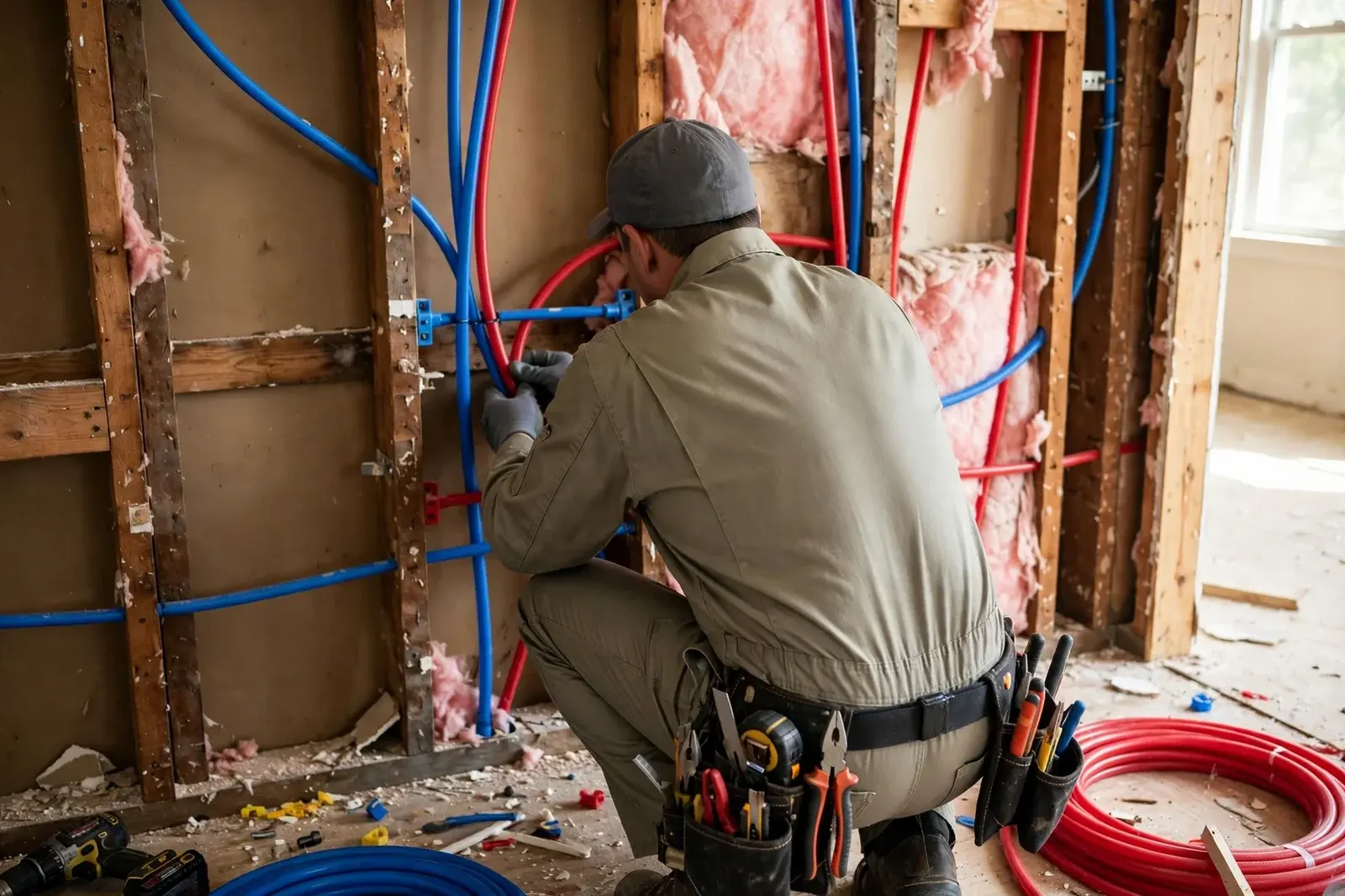
Repiping Services
Repiping replaces a home's worn-out water supply pipes with new PEX or copper pipe. It ends repeat leaks, restores pressure and clears rusty water. A licensed local plumbing company inspects the pipes first, then gives a written quote. The crew works room by room, and the water is usually restored each evening. Call (833) 878-1592 to book an inspection.
Updated 2026-11-18. Prices shown are estimates only.
- $150–$20,000 Typical cost range
- 6 Steps in the visit
- 12 Questions answered
Before & after — repiping
Before & after
Drag the slider to compare the same spot before and after the repair.
Repiping
What is repiping, and when does a home need it?
Repiping is a full replacement of the water supply pipes in a home. The old lines — usually galvanized steel, polybutylene, or copper that has thinned with age — come out of service, and new PEX or copper lines take their place.
The work covers every fixture: kitchen, bathrooms, laundry, and the lines to the water heater. It is the fix for a system that has reached the end of its life, not a patch for one bad joint.
A home needs repiping when the signs point to the system rather than a single spot. Repeat leaks on the same line, brown water in the morning, and pressure that is weak at every tap at once are the usual pattern.
One leak can be repaired. Three leaks in a year, or a pipe material that is known to fail, means the system is the problem.
An inspection with a pressure test settles the question before any wall is opened.
The repipe decision is rarely urgent on the day it is made, and that is the point: a planned repipe in a home with old pipes costs less than an emergency one after a burst. The inspection gives the facts, and the quote gives the price, so the decision can be made calmly.
The inspection is the part that matters most, and it is free to book. A pressure test, a look at the pipe material, and a map of the runs — and the homeowner knows whether the pipes can wait or not.
Homeowners sometimes ask whether a repipe can wait until next year. The honest answer is that it can, if the pipes are not leaking and the pressure holds — but the inspection is what decides, and waiting is a guess without it.
Repiping
How much does a whole-home repipe cost?

A whole-home repipe usually runs $4,500 to $12,000 for PEX and $8,000 to $20,000 for copper. The spread comes from the size of the home, the number of fixtures, and how hard the pipes are to reach.
A small home with open walls sits at the low end. A large home with finished walls, three bathrooms, and a long run to the kitchen sits at the high end.
A partial repipe — one bathroom group or the hot-water lines only — usually runs $2,000 to $6,000.
Those figures are typical national ranges, shown as estimates only. The local company gives a written quote after walking the home and seeing the pipes.
Ask what the quote includes: the permit, the rough-in inspection, the patching, and the cleanup. If a quote looks far below the range, ask what it leaves out.
Permits, patching, and inspection are the items most often missing from a low quote.
The range is wide because homes are different, and the only number that counts is the one written after the inspection. Ask the local company to show PEX and copper side by side, so the choice is made on the numbers for this home.
A quote that lists everything can be compared fairly with another quote that lists everything. The material, the rooms, the permit, the inspection, and the patching should all be there.
The quote is only useful if it can be compared. Two quotes with the same material, the same rooms, and the same inclusions can be compared; two quotes that list different things cannot.
Repiping
PEX or copper: which pipe should a repipe use?
PEX is the usual pick for a whole-home repipe. It costs less, bends around corners with fewer joints, and flexes when water freezes instead of splitting.
Its smooth walls do not collect scale, which helps in hard water. It is rated for about 40 to 50 years in normal use, and it is certified for drinking water when it carries the NSF/ANSI 61 mark.
Copper is the long-life choice: 50 years or more, often 70, with a familiar feel and good hot-water handling. It costs more and takes longer to install, because each joint is soldered by hand.
The local company usually shows both materials and explains which suits the home's water and layout before quoting. Some homes mix the two, with PEX for long runs and copper where it shows.
The material choice is the homeowner's, and the quote should show both. PEX costs less and installs faster; copper lasts longer and handles hot water well.
The installer can explain which suits the home's water and layout.
The installer can explain which material suits the home's water and layout, and the quote should show both prices. Some homes mix the two, with PEX for long runs and copper where it shows.
Copper and PEX both pass inspection, and both last decades. The choice is about the home: its water, its layout, and what the homeowner is willing to pay.
Repiping
What happens during a repipe?

A repipe starts with a visit. The crew tests the water pressure, finds the pipe material, and maps the runs from the main to every fixture.
That map becomes the plan: which walls open, where the new lines run, and where the water is shut off each day. The crew then agrees the material and the routes, puts the price in writing, and files the plumbing permit.
The install takes two to five days for most single-family homes. The crew works room by room, runs new PEX or copper through the walls, attic, or crawl space, and fits a new shutoff valve at each fixture.
Old lines are capped and left in the walls. The system is pressure-tested, the inspector checks the rough-in before the walls close, and the drywall is patched.
The water is usually off only during working hours, and the crew restores it each evening.
The crew works to the plan the inspection produced, and the homeowner knows the price before any wall is opened. The permit is filed, the inspection is booked, and the water is restored each evening through the job.
The crew works to the plan the inspection produced. The permit is filed, the inspection is booked, and the water is restored each evening through the job.
The crew should leave the home tidy each evening. Floors protected, debris removed, and the water back on.
A company that leaves a mess leaves a clue about the rest of the job.
Repiping
Will a repipe damage the walls and floors?
A repipe opens some walls and ceilings to reach the old pipes and run new ones. Good crews cut small, neat openings and patch them after.
The scope of patching is part of the quote, so ask exactly what is included. Drywall patching, texture, and paint are sometimes separate items, and it is better to know that before work starts than after.
Floors are protected during the work, rooms are sealed off from dust, and the crew cleans up each day. The mess is short-lived, usually a few days, and the patching stage puts the walls back.
Homeowners can usually stay in the home through the job. If the home has only one bathroom, the crew plans the work so it is out of use for as short a time as possible.
The patching is part of the quote, and it is worth reading closely. Drywall patching, texture, and paint are sometimes separate items, and it is better to know that before work starts than after.
Drywall patching, texture, and paint are sometimes separate items, and it is better to know that before work starts than after. Ask exactly what the patching covers.
Patching is the part homeowners notice most, because it is what they see. Ask who patches, how many coats, and whether texture and paint are included before the job starts.
Repiping
Does repiping fix low pressure and brown water?
Often, yes, when the cause is narrowed or scaled-up old pipe. Galvanized pipe closes up from the inside over decades, and that shows up as weak flow at every tap.
A repipe restores the full bore. Brown water that appears after the taps have sat overnight and clears after a minute of running is rust flaking off the inside of galvanized steel, and new PEX or copper removes the source.
If only one tap is weak, the cause is usually local: a clogged aerator or a single valve, and a repipe is not needed. If the colour comes from the city supply, the neighbours see it too, and a repipe will not fix it.
A pressure test separates the causes in minutes: good pressure at the main with weak pressure at the taps means the pipes are the problem.
A pressure test separates the causes in minutes, and it is part of the inspection. Good pressure at the main with weak pressure at the taps means the pipes are the problem, and a repipe is the fix.
A pressure test is part of the inspection, and it separates the causes in minutes. Good pressure at the main with weak pressure at the taps means the pipes are the problem.
A repipe is a big job, and it deserves a written quote. The inspection produces it, the homeowner reads it, and the work starts only when it is agreed.
Repiping
Repiping and your home insurance
Home insurers ask about the pipe material when a policy is written or renewed, and old galvanized or polybutylene pipe can raise the premium or be declined. The insurer knows the failure rate of those materials, and it prices the risk into the policy.
A permitted repipe with the paperwork — the permit, the inspection result, and the warranty — can lower the premium or restore cover that was refused. Tell the insurer after the job, and keep the documents where the policy is kept.
Some insurers want proof of the material, and the quote and inspection result give it. A burst-pipe claim on old pipe can be denied if the pipe was known to be failing, so the repipe is worth doing before the leak, not after.
Repiping
How Repiping works, step by step
Repiping follows the same steps whatever the home. First the crew inspects: a pressure test, a look at the pipe material, and a map of the runs from the main to every fixture.
That map becomes the plan, and the plan becomes the written quote.
Then the crew replaces the lines, room by room, fitting new shutoff valves at each fixture and capping the old lines. The system is pressure-tested, the inspector checks the rough-in, and the walls are patched.
The water is off only during working hours.
Repiping
Repiping cost breakdown: where the money goes
Where the money goes in Repiping depends on the home. A small home with open access spends most of it on the pipe and the crew's days.
A large home with finished walls spends more on opening and patching.
Copper costs more than PEX in material and in time, because each joint is soldered by hand. The written quote should show the material, the labour, the permit, the inspection, and the patching, so the homeowner can see every dollar.
Repiping
Repiping or a repair: when replacement wins
The repair-or-replace question is answered by the inspection, not by a guess. The crew tests the pressure, looks at the pipe material, and maps the leak history.
One leak on a young system is a repair.
Three leaks in a year, or a system made of galvanized steel or polybutylene past its life, is a replacement. The inspection gives the facts, and the quote gives the price of each option, so the homeowner can compare them.
Repiping
What to expect during Repiping
The disruption of Repiping is real but short. A few days of cutting and patching, water off during working hours, and the crew in and out of the rooms where the pipes run.
What makes it bearable is the plan: the crew says each morning what will happen that day, the water is restored each evening, and the rooms are cleaned before the crew leaves. Most families stay in the home through the whole job.
Repiping
After Repiping: care, warranty, and records
Once Repiping is done, the homeowner's job is mostly to keep the records. The permit, the inspection result, and the warranty belong in the home's folder, next to the written quote.
The pipes themselves need little: normal use, a check if the pressure changes, and a call to the company if anything drips. New shutoff valves at each fixture make a future leak easy to stop at one tap.
Repiping
Repiping and your home's value
Repiping helps a home's value in a plain way: it removes a problem buyers are afraid of. Old galvanized or polybutylene pipe is a known defect, and a buyer who finds it will ask for a credit or a replacement.
A repipe with a permit, an inspection result, and a warranty answers that demand before it is made. The paperwork goes with the home, and the pipes stop being a negotiation point.
Repiping
Where Repiping is available
Every city on this site can book Repiping, and the list runs from the largest down. The coverage is by ZIP code, and the local company checks it before booking so nobody is promised a visit that cannot happen.
The service area is the whole state, and the phone number is the same in every city. Call (833) 878-1592 and say which city the home is in, and the dispatcher will book the inspection.
Repiping
Repiping and the other repipe services
Repiping overlaps with the other services on this site, and that is by design. A home with polybutylene pipe needs polybutylene replacement, which is usually done in PEX.
A home with galvanized pipe needs galvanized replacement, which can be PEX or copper.
The service names describe the problem and the material, not different companies or different crews. One local company does all six, and the inspection is what picks the right one for the home.
Repiping
Reading the signs: what they mean for Repiping
The signs of failing pipe are easy to miss one at a time, and this page puts them together for Repiping. A water bill that jumps, a damp patch with no fixture above it, and hot water running out sooner than it used to.
Any one of those can have another cause. Together, they point to the system, and the inspection is the way to be sure before spending anything.
Repiping
Questions to ask before Repiping
Five questions cover Repiping before it starts: the material, the scope, the permit, the patching, and the warranty. The company should answer each one and put the answers in writing.
Ask also about the crew: who is coming, how many days, and what the shutoff plan is each day. A company with a clear plan will say so, and the homeowner will know what to expect.
Repiping
How Repiping is inspected
Every Repiping job is inspected, and the inspection is the part that protects the homeowner. The inspector is from the city or county, not the company, and the permit number is the record of it.
If the inspector finds a problem, the crew fixes it and the inspection is repeated. The walls are not closed until the inspection passes, and the permit number goes to the homeowner with the warranty.
Repiping
Repiping in older homes
Older homes are where Repiping is needed most, and they are also where the job takes the longest. The pipes are usually galvanized steel or polybutylene, the walls are plaster or lath, and the access is tighter than in a newer home.
The inspection matters more in an old home, because the pipe material and the leak history are harder to read from the surface. The crew maps the system before cutting, and the quote reflects the home's age and access.
Repiping
The materials used in Repiping
The material choice in Repiping is between PEX and copper, and both are approved for drinking water. PEX is certified to NSF/ANSI 61, and copper has been the standard for decades.
The fittings matter as much as the pipe: crimp rings or expansion fittings for PEX, soldered joints for copper. The installer should name the system on the quote, and the pipe should carry its rating.
Repiping
Timing your Repiping
The best time for Repiping is before the pipes fail, and the inspection is how the homeowner knows when that is. A planned job costs less than an emergency one, and it can be booked when the household is ready.
Lead times run a few weeks in busy seasons, so the inspection should be booked early. The job itself takes a few days, and the water is restored each evening.
Signs you may need repiping
- Brown or rusty water, especially first thing in the morning
- Low water pressure at several taps at once
- The same pipe leaking more than once in a year
- Visible corrosion or green crust on exposed pipes
- Grey plastic pipe near the water heater (polybutylene)
- Dull grey magnetic pipe with threaded joints (galvanized steel)
- A water bill that climbs with no new use in the home
- Damp patches on a wall or ceiling with no fixture above
- Hot water running out sooner than it used to
- Pipes knocking or groaning when a tap opens
How it works
- 1
Step 1 — Inspection and pressure test
The crew tests the water pressure, finds the pipe material and maps the runs from the main to every fixture.
- 2
Step 2 — Written quote and permit
The local company quotes the job in writing and files the plumbing permit.
- 3
Step 3 — Install the new lines
New PEX or copper runs through the walls, attic or crawl space, and each fixture gets a new shutoff valve.
- 4
Step 4 — Test, inspect and patch
The system is pressure-tested, the inspector checks the rough-in, and the walls are patched and cleaned up.
- 5
Step 5 — Patch and finish
The crew patches every opening, sands it smooth, and leaves the walls ready for texture and paint.
- 6
Step 6 — Walkthrough and records
The homeowner runs every fixture with the crew, and the permit number, inspection result, and warranty are left with the home's records.
Repiping cost
What does it cost?
All figures are typical national ranges, shown as estimates only. The written quote from the local company replaces them once the pipes have been inspected.
| Service | Typical range (estimate) | Notes |
|---|---|---|
| Whole-home repipe (PEX) | $4,500 – $12,000 | Most 2–3 bed homes |
| Whole-home repipe (copper) | $8,000 – $20,000 | Longer-lasting metal pipe |
| Partial repipe (one area) | $2,000 – $6,000 | One bathroom or hot lines |
| Polybutylene replacement | $5,000 – $15,000 | Full grey-pipe swap |
| Galvanized pipe replacement | $5,000 – $15,000 | Old steel out, new pipe in |
| Pressure test & pipe inspection | $150 – $400 | Standalone visit |
Prices are estimates only. The local company that does the work sets its own final pricing.
Questions about repiping