
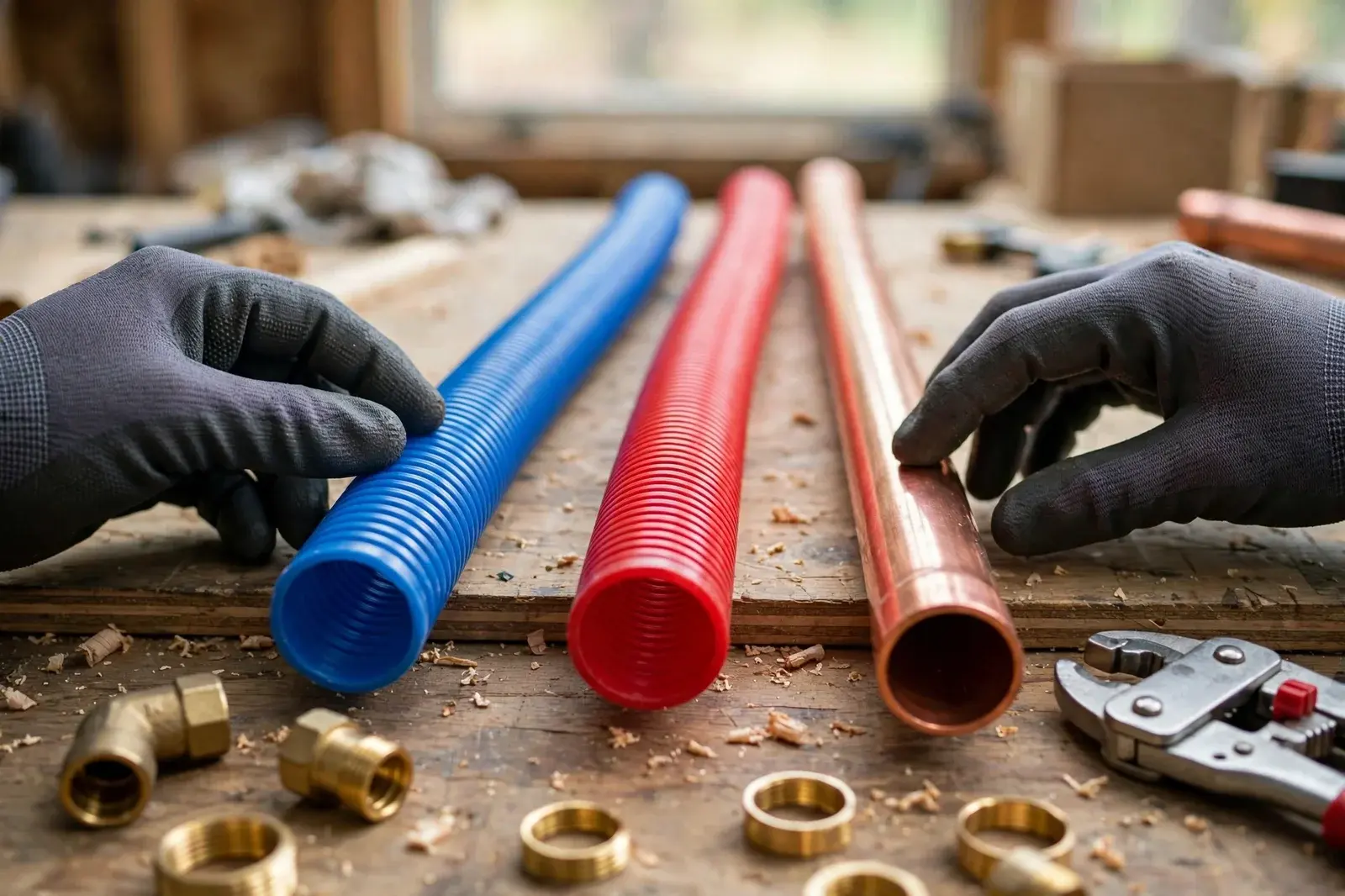
PEX vs Copper Repiping: Which Pipe Should You Choose?
PEX costs less and installs faster. Copper lasts longer and handles heat better. Both fix the same problems: repeat leaks, brown water, and low pressure. This guide compares them in detail so the choice is made with the facts in front of you.
Updated 2026-11-18. Prices shown are estimates only.
PEX vs copper: the short answer
PEX costs less and installs faster. Copper lasts longer and handles heat better. Both are approved for drinking water, both are installed by the same licensed crews, and both fix the same problems: repeat leaks, brown water, and low pressure. The choice is not a test with one right answer. It is a trade between price, time, and lifespan.
A whole-home repipe usually runs $4,500 to $12,000 for PEX and $8,000 to $20,000 for copper. PEX is rated for about 40 to 50 years. Copper commonly lasts 50 years or more, often 70. The rest of this guide works through the differences in detail, so the homeowner can make the choice with the facts in front of them.
What PEX is, and how it behaves
PEX is cross-linked polyethylene, a flexible plastic pipe that comes in coils and bends around corners. It connects with crimp rings or expansion fittings rather than solder, and it threads through walls with fewer openings than rigid pipe. It does not corrode, it does not build up scale on its smooth walls, and it flexes when water freezes instead of splitting.
PEX made for drinking water is certified to NSF/ANSI 61, which limits what can leach into water. It is used in millions of US homes. Its limits are real: it should not sit in direct sunlight for long, and it is not the pipe for the exposed run at a water heater vent in some codes. Some people notice a slight taste in the water for the first days after install; running the taps clears it.
What copper is, and how it behaves
Copper is rigid metal pipe, joined with soldered fittings, and it has carried drinking water in US homes for close to a century. It handles hot water well, it stays rigid on long runs, and it has a track record that PEX cannot yet match in years of service. A copper system looks the way plumbing has looked for generations: straight runs, clean joints, and metal pipe at every fixture.
Copper's weak point is pinhole leaks. In some water conditions, the wall thins at a spot and lets go, and once one section is thin the rest of the system is usually close behind. Copper can also tick or knock as it expands with hot water, especially where it is held tight. Good installation leaves room for movement and clips the pipe properly.
Cost, time and disruption compared
PEX wins on price and time. The material is cheaper, and the install is faster: a PEX repipe usually finishes about a day sooner than the same job in copper, because flexible runs need fewer wall openings and fewer joints. For a two-bedroom home, the saving is often $3,000 to $5,000. For a large home, it can be $6,000 to $8,000.
Copper wins on lifespan. The gap is real but small over a normal stay in a home: PEX at 40 to 50 years against copper at 50 to 70. Disruption is similar for both — two to five days of pipe work, water off only during working hours, and a day or two of patching after. PEX opens fewer walls; copper opens more, because rigid pipe cannot thread around a corner.
Water quality, freezing and noise
Hard water favours PEX. Scale does not grip its smooth walls the way it grips metal, so the bore stays clear and the pressure stays up. Copper also works in hard water but can scale up over time. In very hard water, a water softener is a separate decision, and the installer can advise on it.
Freezing favours PEX too: it flexes instead of splitting when water inside it freezes. Copper splits. Noise favours PEX as well: it is quieter, because it flexes, while copper can tick as it expands with hot water. Neither pipe is silent by accident, though — both need proper supports and room to move.
Which one should you choose?
Choose PEX when the budget matters most, when the job needs to finish fast, when the home is in a cold climate, or when the water is hard. Choose copper when the plan is to stay in the home for decades, when the pipes are visible in a basement or utility room, or when the homeowner simply trusts metal pipe more.
Some homes mix the two: PEX for the long runs, copper where it shows or where heat is highest. The installer can explain the mix and price each version. Either way, the new pipe is a large step up from galvanized steel or polybutylene. Get the quote in writing with both options, and let the water test and the home — not the sales pitch — decide.
The bottom line on PEX vs copper
PEX costs less and installs faster. Copper lasts longer and handles heat better. Both are approved for drinking water, both are installed by the same licensed crews, and both fix the same problems. The choice is a trade between price, time, and lifespan, and there is no wrong answer — only the answer that fits the home, the water, and the budget.
Choose PEX when the budget matters most, when the job needs to finish fast, when the home is in a cold climate, or when the water is hard. Choose copper when the plan is to stay in the home for decades, when the pipes are visible, or when the homeowner trusts metal pipe more. Some homes mix the two, with PEX for the long runs and copper where it shows.
Whatever the choice, get the quote in writing with both options priced, and let the water test and the home decide. The new pipe is a large step up from galvanized steel or polybutylene either way. Call (833) 878-1592 to book an inspection and a written quote with both materials listed.
How do you read a repipe quote?
Read the quote as a list of promises. Each line is something the company will do: the material it will install, the rooms it will cover, the permit it will file, the inspection it will book, the patching it will finish, and the warranty it will stand behind.
A promise that is not written down is not a promise. If the quote does not name the material, the company has not promised one. If it does not mention the permit, it has not promised to file one. The written quote is the record, and the homeowner should read it as one.
What should the written quote list?
Seven lines make a complete quote: the material, the scope, the permit, the inspection, the patching, the cleanup, and the warranty. The material line names PEX or copper and the brand. The scope line names the rooms and the fixtures. The permit line names the city filing, and the inspection line names the rough-in check.
The patching line says what the walls get after the work: patching, texture, and paint, or patching only. The warranty line says how long the work and the material are covered, and by whom. A quote with all seven can be compared; a quote without one of them cannot.
How long do new pipes last?
A new PEX system should last 40 to 50 years, and a new copper system 50 to 70. Those are the makers' ratings for normal use, and they assume the water is not aggressive, the pressure is in range, and the installation was done to code.
What shortens a pipe's life is usually not the pipe: it is the water chemistry, a pressure regulator that has drifted high, or a joint that was made badly. That is why the inspection matters — the rough-in check catches the bad joint while the walls are still open, and the pressure test proves the system is tight.
What is a pressure test, and why does it matter?
The pressure test is simple: the system is filled, the gauge is watched, and a drop means a leak. It takes minutes, and it is done before the walls are closed, so any leak found is easy to reach.
The inspector watches the same gauge, and the inspection does not pass until the system holds. That is why the test matters: it is the independent proof that the new lines are sound, and it is recorded with the permit. A repipe without a pressure test is a job without proof.
How do you choose between PEX and copper?
PEX wins on price and time. Copper wins on lifespan and heat tolerance. Both are approved for drinking water, both are installed by the same licensed crews, and both fix the same problems: repeat leaks, brown water, and low pressure.
The deciding factors are the home, the water, and the budget. Hard water favours PEX, because scale does not grip its smooth walls. A long stay favours copper, because it lasts 50 to 70 years. A tight budget favours PEX, because it usually saves a few thousand dollars. Get both prices in writing and compare them.
What happens to the old pipes?
Old pipe is taken out of service, not taken out of the house. The crew caps each old run, so no water can enter it, and leaves it in the wall. The new lines run through the same routes or through new ones, and the old pipe simply stays where it is, dry and harmless.
The exception is pipe that is easy to reach: in an open basement or crawl space, the old lines may come out. The crew will say what it plans to remove and what it plans to leave, and the cut-out sections are taken away with the debris at the end of the job.
How much mess does a repipe make?
The disruption is real but short. A few days of cutting and drilling, water off during working hours, and the crew in and out of the rooms where the pipes run. The crew protects the floors, seals the work rooms against dust, and cleans up before leaving each evening.
Most families stay in the home through the whole job. If the home has only one bathroom, the crew plans the work so it is out of use for as short a time as possible. The mess ends with the patching, and the home is put back as it was.
Can you stay in the home during the work?
Staying in the home is the usual arrangement. The crew works room by room, the water is restored each evening, and the household uses the kitchen and the working bathrooms overnight. The noise is daytime only, and the dust is contained to the work rooms.
The homeowner's part is small: clear access to sinks, toilets, the water heater, and the main shutoff, and move items away from walls where pipes run. The crew does the rest, and the final walkthrough runs every fixture with the homeowner before sign-off.
What does the permit protect?
A permit protects the homeowner, not the city. It creates a record that the work was filed, inspected, and passed, and that record is what a buyer or an insurer asks for. Without it, the repipe is a claim, not a fact.
The inspection is the part that matters most: an independent inspector checks the work while the walls are still open, and anything wrong is fixed before the drywall goes back. A company that files the permit and books the inspection is doing the job properly.
How do you check a plumbing company's licence?
The licence check takes a few minutes and it is worth doing. Ask the company for its licence number, then look it up with the state licensing board. The record shows whether the licence is current and what class of work it covers.
Also ask for proof of insurance, and ask for the permit number before work starts. A company that files permits, books inspections, and shows its licence is a company that can be trusted with a multi-day job inside the home.
What is the difference between a repipe and a repair?
Repair and repipe are two different jobs with two different prices. A repair costs a few hundred dollars and fixes one spot. A repipe costs thousands and replaces the system.
The repair is right when the rest of the system is sound: good pressure elsewhere, pipe with life left, and a short leak history. The repipe is right when the system is failing: repeat leaks, brown water, weak pressure at every tap. The pressure test and the pipe material tell the crew which case it is.
When is the best time to repipe?
There is no wrong season for a repipe, but there is a wrong way to time it: waiting until the pipe bursts. A burst brings water damage, a wet wall, and a repair bill on top of the job.
A planned repipe is booked when the household is ready, the water shutoffs are planned, and the patching is included in the quote. The shoulder seasons are the easiest to book; summer and the weeks before the holidays fill up first, and the lead time grows.
What records should you keep after the job?
Keep four documents: the permit number, the inspection result, the warranty, and the material list. Those four show the repipe was done properly, inspected, and warranted, and they answer the first question a buyer or an insurer asks about the plumbing.
Keep the written quote too, so the scope of the work is on record: which lines were replaced, which material was used, and what the patching included. If the home is sold, that folder is part of the value. If a problem ever appears, it is the record of what was done and who stands behind it.
How do you prepare a home for a repipe?
Clear access before the crew arrives: move items away from sinks, toilets, the water heater, and the main shutoff, and clear the walls where pipes run. Cover furniture near the work areas, and keep the driveway open so the crew can bring in pipe and tools.
The crew will say which rooms it needs first, and the homeowner can plan around that. Pets and small children should be kept out of the work rooms while walls are open. The preparation takes an hour or two, and it saves the first morning of the job.
What should you do in the first week after a repipe?
The first week is the check week. Run every fixture, look at every valve, and check the patching as it dries. A drip at a new valve, a patch that cracks, or a tap that runs weak should be reported to the company at once, while the crew is still nearby and the work is under warranty.
Keep the pressure in range, usually 40 to 80 psi, and watch the water meter with every tap off: a still meter means the system is tight. The final walkthrough catches most of these things, and the first week catches the rest.
Signs you may need repiping
- A home that needs a full repipe
- Hard water that scales metal pipe
- Cold winters that freeze exposed pipe
- A budget that favours a faster install
- A homeowner planning to stay for decades
- Copper that has pinholed before
- A pipe that has leaked twice in the same year
- Water pressure that falls when a second tap opens
How it works
- 1
Step 1 — Look before cutting
The crew checks the pressure, identifies the pipe material and maps every run before any wall is opened, so the openings stay small.
- 2
Step 2 — Quote, then permit
The quote lists the material, the scope and the patching. The company then files the permit and books the inspection.
- 3
Step 3 — Replace, room by room
The crew works room by room, replacing old lines with new PEX or copper and testing as it goes.
- 4
Step 4 — Final check and patching
Every tap is tested, the inspection is signed off, and the drywall is patched and the site cleaned.
- 5
Step 5 — Patching the walls
Drywall patching follows the pipe work, and the quote says whether texture and paint are included. The walls are closed only after the inspection passes.
- 6
Step 6 — Final walkthrough
Every tap, toilet, and shower is run with the crew before sign-off, and the permit number, inspection result, and warranty are kept with the home's records.
What does it cost?
All figures are typical national ranges, shown as estimates only. The written quote from the local company replaces them once the pipes have been inspected.
| Service | Typical range (estimate) | Notes |
|---|---|---|
| Whole-home repipe (PEX) | $4,500 – $12,000 | Most 2–3 bed homes |
| Whole-home repipe (copper) | $8,000 – $20,000 | Longer-lasting metal pipe |
| Partial repipe (one area) | $2,000 – $6,000 | One bathroom or hot lines |
| Polybutylene replacement | $5,000 – $15,000 | Full grey-pipe swap |
| Galvanized pipe replacement | $5,000 – $15,000 | Old steel out, new pipe in |
| Pressure test & pipe inspection | $150 – $400 | Standalone visit |
Prices are estimates only. The local company that does the work sets its own final pricing.