
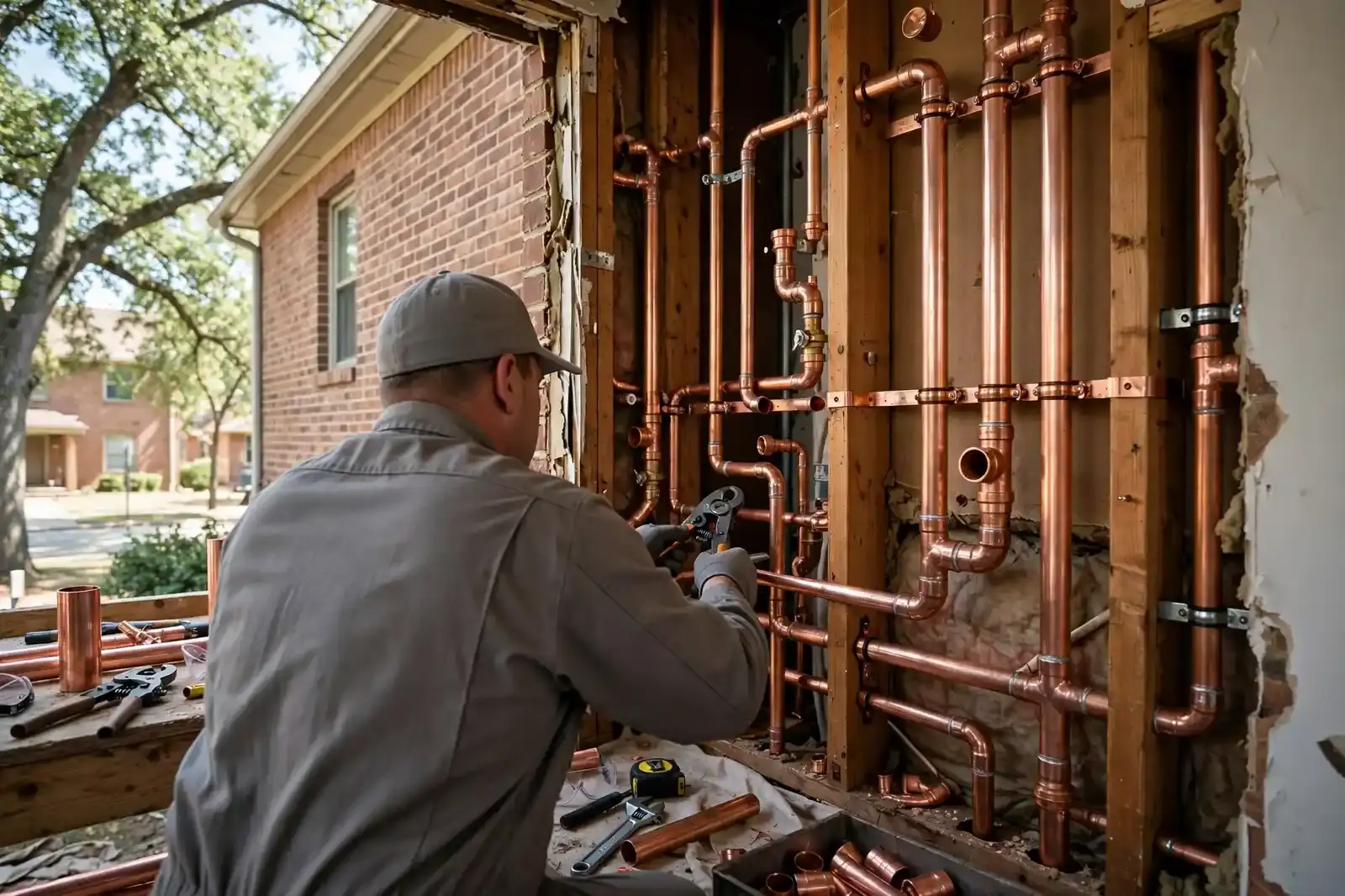
Repiping in Omaha, NE
Homeowners in Omaha repipe when the old pipes keep leaking, the pressure has fallen, or the water runs brown. New PEX or copper lines replace the failing system, and the work is permitted and inspected. A local plumbing company gives the written quote after looking at the pipes. Call (833) 878-1592.
Updated 2026-11-18. Omaha, NE · Douglas County · Population 489,265. Prices shown are estimates only.
- 489,265 Population
- Douglas County
- 48 ZIP codes served
Before & after in Omaha
Before & after
Drag the slider to compare the same spot before and after the repair.
Repiping in Omaha
Rusty or brown water in Omaha
Homeowners in Omaha sometimes live with brown water for years, treating it as a quirk. It is a warning.
The rust that colours the water is the pipe wall itself wearing away, and a wall that thin eventually leaks.
If both hot and cold run brown after sitting overnight, the pipes are the source, and the rust is coming from galvanized steel. A repipe fixes the pipe side of the problem.
The heater side is fixed by flushing the tank or replacing the heater.
The rust that colours the water is the pipe wall itself wearing away, and a wall that thin eventually leaks. A repipe in Omaha removes the source.
The service area in Omaha covers 48 ZIP codes, from 68101 to 68198, all inside Douglas County.
Repiping in Omaha
After the repipe: what changes in Omaha homes

Once the repipe in a Omaha home is done, the maintenance picture changes. New PEX or copper needs little attention: no rust, no scale buildup, and no thinning walls to watch.
The homeowner's job is to keep the pressure in range and to fix small fixture leaks promptly.
The crew leaves the system tested and the water clear. If the home has a pressure regulator, the crew checks it is set correctly.
After that, the pipes should be the last thing on the homeowner's mind for decades.
The paperwork matters as much as the pipes: the permit, the inspection result, and the warranty go with the home's records.
The homes in Omaha, Nebraska span 48 ZIP codes, and the local company confirms coverage by ZIP before booking.
Repiping in Omaha
Repiping and your water heater in Omaha?
The hot-water lines fail first in most homes, because heat speeds corrosion, so the heater and its connections get close attention during a repipe. The crew checks the dielectric unions, the shutoff valve, and the expansion tank if there is one.
A corroded connection at the heater is often the first leak a homeowner notices.
Replacing the heater at the same time as the repipe is a practical choice when it is old. The walls are already open, the water is already off, and the crew is already on site.
The quote should list the heater separately, so the homeowner can see what it adds.
The water heater in Omaha is checked during the repipe inspection, and the crew looks at its age, its connections, and its size for the home.
In Omaha, about 489,265 people live across 48 ZIP codes in Douglas County, and the local company covers all of them.
Repiping in Omaha
How much does repiping cost in Omaha?
Repiping a home in Omaha is priced by the job, not by the foot, because every home's pipe layout is different. As a guide, most whole-home repipes fall between $4,500 and $12,000 for PEX and $8,000 and $20,000 for copper.
Homes with a slab foundation, where pipes are rerouted through the attic, tend toward the higher end.
Ask the local company to show the quote in writing with the material named, not just a price. PEX and copper should both be priced, so the choice is yours.
If the two prices are close, the dearer material may be worth it; if they are far apart, the cheaper one usually is.
A repipe is a large job, and the quote should be read carefully before anything is agreed. The material, the rooms, and the patching should all be listed.
Omaha has about 489,265 residents, and the repipe coverage here runs to 48 ZIP codes across Douglas County.
Repiping in Omaha
What happens during a repipe in Omaha?

Day one in a Omaha home is mostly inspection and setup. The crew confirms the pipe material, checks the main shutoff and the pressure regulator, and marks the openings.
The water is shut off while the first lines are cut, then restored in the evening.
Then the crew works room by room. Old lines are cut out or capped, new PEX or copper goes in, and the water is tested before the walls are closed.
An inspection usually follows the rough-in. The last step is patching, cleanup and a final pressure check.
Water is usually restored each evening during a repipe in Omaha, so the home stays liveable through the job.
About 489,265 people live in Omaha, and every one of the 48 covered ZIP codes is served from Douglas County.
Repiping in Omaha
Pinhole leaks and slab leaks in Omaha
Pinhole leaks in Omaha usually start where copper is thinnest: at joints, at bends, or where the water is most aggressive. The leak itself is small, but the water runs inside the wall for days before it shows, soaking framing and drywall.
The lasting fix is a repipe that moves the lines out of the slab — usually through the attic or walls — so there is no water line under the floor to fail again. Patching one slab leak leaves the rest of the old line in place.
Breaking the slab to patch one spot leaves the rest of the old line under the floor, and a home that has had one slab leak often has more coming.
About 489,265 people live in Omaha, and every one of the 48 covered ZIP codes is served from Douglas County.
Repiping in Omaha
Galvanized pipe in older Omaha homes
Galvanized pipe fails slowly and then all at once. For decades the rust builds up inside, narrowing the bore until the shower runs weak and the washing machine fills slowly.
Then a section rusts through and leaks.
Galvanized pipe has a working life of roughly 40 to 60 years, and most of it is past that now. The signs are familiar: weak pressure at every tap, brown water first thing in the morning, and rust flakes in aerators.
A repipe replaces the system rather than patching it.
There is no cleaning that restores galvanized pipe. The wall is thin and rusted, and the fix is a repipe with PEX or copper.
The service area in Omaha covers 48 ZIP codes, from 68101 to 68198, all inside Douglas County.
For homeowners in Omaha, the service area is 48 ZIP codes in Douglas County, from 68101 through 68198. The city population is about 489,265.
The crew books by the home, and the quote follows the inspection, not the ZIP code.
Repiping in Omaha
Soil and ground movement under Omaha homes
Where pipe meets soil, corrosion can work from the outside in, especially on older steel. A line buried without protection rusts faster than one in a dry wall.
The fix that lasts is a reroute, not a patch. A home that has had one slab leak often has more coming, because the rest of the old line is the same age and in the same soil.
New lines run above ground after a repipe in Omaha, so soil no longer touches them and they can be inspected and repaired.
Repiping in Omaha covers the whole city — about 489,265 residents and 48 ZIP codes in Douglas County.
Repiping in Omaha
Freeze risk for pipes in Omaha
Cold snaps do not need to be common in Omaha to matter — one hard freeze is enough to split a pipe in an unheated space. The damage is not the split itself but the water that runs while nobody notices.
New PEX lines reduce the risk, and insulation removes most of what is left. The inspection notes which runs are exposed, and the crew plans around them.
One hard freeze is enough to split a pipe in an unheated space, and the damage is the water that runs while nobody notices.
The homes in Omaha, Nebraska span 48 ZIP codes, and the local company confirms coverage by ZIP before booking.
Repiping in Omaha
Why waiting costs more in Omaha
Pipes do not heal, and in Omaha the older the system the faster the failures come. Galvanized pipe rusts from the inside, copper pits, and polybutylene can split with little warning.
The first leak is a warning; the second is a pattern.
A planned repipe is also calmer: the crew is booked, the water shutoffs are planned, and the patching is included. An emergency repipe starts with shutting the water off and drying the home out.
If the signs are already there, the planned job is the better one.
Waiting is a gamble with the pipe wall, and the wall only gets thinner. An inspection in Omaha costs little and says whether the pipes can wait.
With about 489,265 residents, Omaha is one of the larger cities in Nebraska where repiping is available, and the local company serves the whole city.
Repiping in Omaha
Low water pressure in Omaha: pipes or something else?
Weak pressure in a Omaha home can come from the street, the regulator or the pipes, and the test tells them apart. A gauge on the main shows what the supply delivers.
A gauge inside shows what the home keeps.
A plumber checks it with a gauge at the hose bib and at a tap. If the main reads well and the taps read low, the loss is inside the home's pipes.
That is a repipe decision, not a fixture decision.
Low pressure that affects the whole home in Omaha is rarely a single fixture. It is the system, and the inspection finds which part of it.
Omaha sits in Douglas County, and the 48 ZIP codes covered here run from 68101 to 68198.
Repiping in Omaha
What does a repipe inspection find in Omaha?
A repipe inspection starts with a pressure test. A gauge on the main shows what the supply delivers, and a gauge inside shows what the home keeps.
When the gap is large, the home's own pipes are eating the pressure. The test takes minutes and settles whether the pipes are the problem.
The map also finds the surprises: a bathroom added in the 1980s with polybutylene, a kitchen moved in a renovation, or pipes that change material halfway through the house. The quote reflects the map, not a guess.
The inspection is how the homeowner in Omaha finds out whether the pipes can wait or not, before spending anything.
The service area in Omaha covers 48 ZIP codes, from 68101 to 68198, all inside Douglas County.
Repiping in Omaha
PEX or copper: what fits Omaha homes?
PEX is the usual pick in Omaha for a whole-home repipe. It costs less, bends around corners with fewer joints, and flexes when water freezes instead of splitting.
Its smooth walls do not collect scale, which helps in hard water. It is rated for about 40 to 50 years.
The practical difference is price and time: PEX usually saves a few thousand dollars and a day of work. The durability difference is real but small over a normal stay in a home.
The quote should show both options so the choice is yours.
Whatever the material, the installation matters more: clean joints, proper supports, and a pressure test at the end. Ask the company how it tests its work.
The service area in Omaha covers 48 ZIP codes, from 68101 to 68198, all inside Douglas County.
Repiping in Omaha
Permits and inspections for repiping in Omaha
A repipe permit in Omaha is usually a simple plumbing permit, and the plumbing company deals with it. The homeowner's part is small: confirm the permit is filed, keep the number, and be available for the inspection if the company asks.
If anything needs fixing, it is fixed while the walls are still open — which is the point of inspecting at that stage. The local company handles the scheduling, and the homeowner does not need to be present, though many choose to be.
The inspector in Omaha checks the material, the joints, the valves, and the pressure test before signing off on the rough-in.
In Omaha, about 489,265 people live across 48 ZIP codes in Douglas County, and the local company covers all of them.
Repiping in Omaha
Polybutylene pipes in Omaha homes
Polybutylene is a grey plastic supply pipe fitted in many homes built from the late 1970s to the mid-1990s. In Omaha, homes of that age should be checked for it: look for grey plastic pipe near the water heater or under sinks, often stamped PB2110.
The fix is a replacement, not a repair: the old pipe comes out of service and new PEX or copper goes in. The work takes a few days, the water is restored each evening, and the walls are patched after.
Call (833) 878-1592 to have the pipe checked.
If the home in Omaha was built from the late 1970s to the mid-1990s, the pipe near the water heater will show whether it is polybutylene.
In Omaha, about 489,265 people live across 48 ZIP codes in Douglas County, and the local company covers all of them.
Repiping in Omaha
How long does a repipe take in Omaha?
For a home in Omaha, expect two to five days of pipe work for a full repipe, plus patching. Small homes finish fast; large homes with many fixtures and long runs take longer.
Homes where the pipes are rerouted through the attic take a little longer than homes where the old routes are reused.
The rough-in inspection happens before the walls are closed, and the inspector's visit can add a day of waiting. Patching then takes a day or two.
From the first cut to the last patch, most homes are done inside a week.
The timeline for a repipe in Omaha also depends on the inspection office. A busy office can add a day of waiting while the walls stay open.
The service area in Omaha covers 48 ZIP codes, from 68101 to 68198, all inside Douglas County.
Repiping in Omaha
Water hardness in Omaha: what it does to pipes
Hard water does not damage PEX the way it damages metal pipe, and that is one reason PEX is common in repipes in Omaha. Copper scales too, though more slowly than steel.
If the water is very hard, the new pipes will scale up more slowly than the old ones, but a softener is still the fix for hard water itself. The repipe and the softener are two different jobs, and the crew will say so plainly.
White crust on fixtures is the visible sign of hard water, and the same mineral builds up inside the pipes unseen.
In Omaha, about 489,265 people live across 48 ZIP codes in Douglas County, and the local company covers all of them.
Repiping in Omaha
Your water utility and shutoff in Omaha
The water meter belongs to the utility and sits at the street or in a meter box, and the utility owns the line up to it. The homeowner owns the pipes from the meter into the house, and that is what a repipe covers.
The utility is not involved in a repipe, since the work is on the homeowner's side of the meter. The permit and the inspection are with the city building department, not the water company.
The water is shut off at the main during working hours and restored each evening, and the crew gives the plan each morning.
The service area in Omaha covers 48 ZIP codes, from 68101 to 68198, all inside Douglas County.
Signs you may need repiping
- The same pipe leaking more than once in a year
- Slow-filling washing machine or dishwasher with clean filters
- Green crust on copper or rust on steel shows the pipe is corroding
- A musty smell near a wall where a pipe runs
- A main shutoff valve that no longer turns or seals
- A pipe that has frozen and split in a cold snap
- Grey plastic pipe by the heater is often polybutylene and worth checking
- An insurer asking about polybutylene or galvanized pipe
- A water bill that jumps with no clear reason
- Brown or rusty water, especially first thing in the morning
How it works
- 1
Step 1 — Water test first
Before any wall is opened, the crew checks the pipe material, tests the pressure and maps the system.
- 2
Step 2 — Confirm the scope
PEX and copper are both priced on the quote, so the homeowner can compare the two before choosing.
- 3
Step 3 — New lines, new valves
Old lines are drained, capped, and left in the walls, since pulling them out would open far more wall.
- 4
Step 4 — Test, inspect and patch
The crew clears debris and vacuums the work rooms daily, so the home stays liveable through the job.
- 5
Step 5 — Patch, sand, clean
The crew patches each opening, sands it smooth, and cleans the room before moving on.
- 6
Step 6 — Last walk and paperwork
The crew walks the home with the homeowner, tests every fixture, and leaves the permit and warranty paperwork.
Repiping cost in Omaha
What does it cost?
The table shows what most US homes pay for each job, as typical ranges and estimates only. The local company confirms the figure for a specific home in writing.
| Service | Typical range (estimate) | Notes |
|---|---|---|
| Whole-home repipe (PEX) | $4,500 – $12,000 | Most 2–3 bed homes |
| Whole-home repipe (copper) | $8,000 – $20,000 | Longer-lasting metal pipe |
| Partial repipe (one area) | $2,000 – $6,000 | One bathroom or hot lines |
| Polybutylene replacement | $5,000 – $15,000 | Full grey-pipe swap |
| Galvanized pipe replacement | $5,000 – $15,000 | Old steel out, new pipe in |
| Pressure test & pipe inspection | $150 – $400 | Standalone visit |
Prices are estimates only. The local company that does the work sets its own final pricing.
Questions about repiping in Omaha