
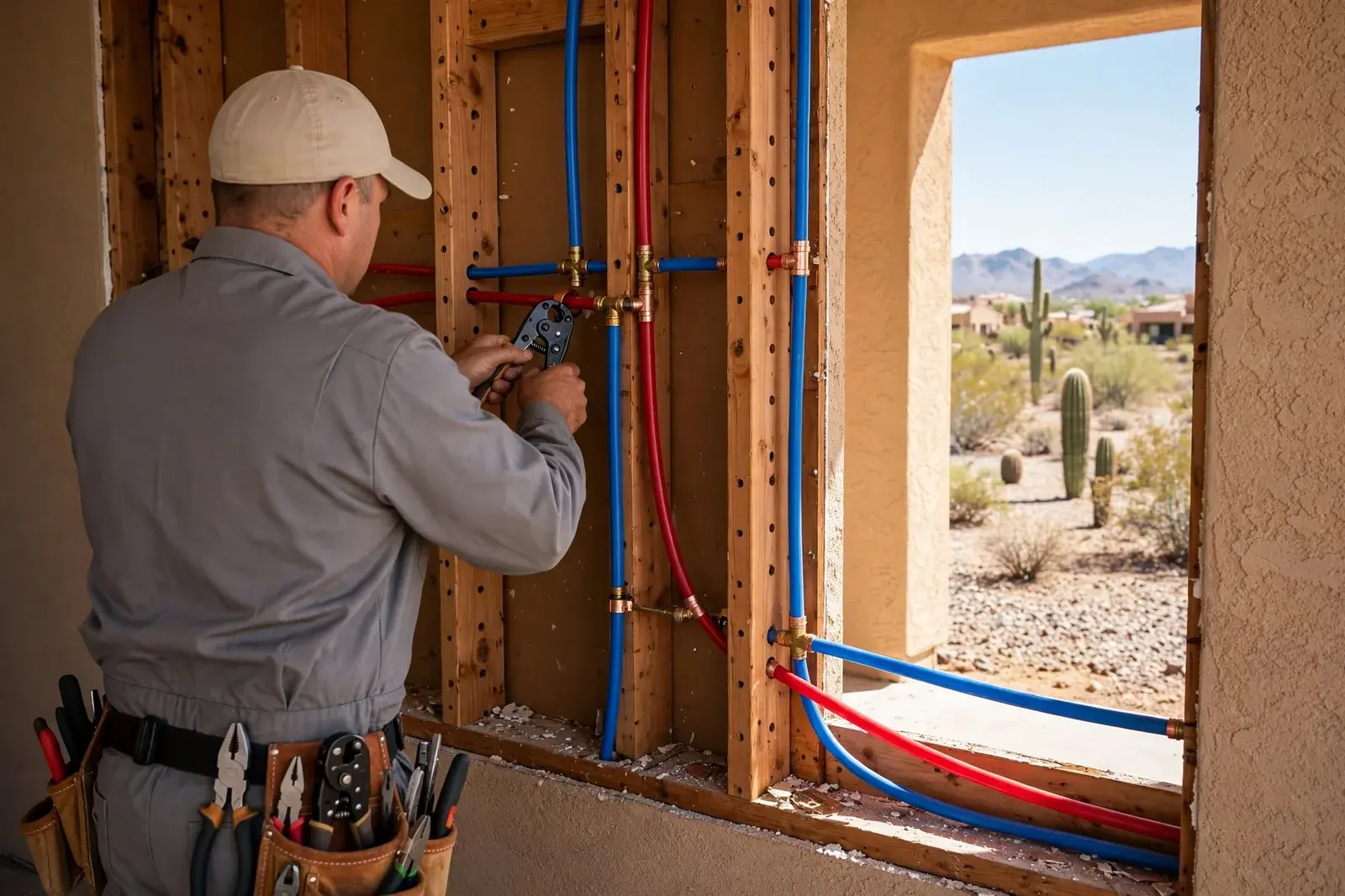
Repiping in Phoenix, AZ
If the pipes in a Phoenix home are old enough to leak, rust or choke the pressure, repiping replaces them with new PEX or copper throughout the home. The crew works room by room, tests the water, and patches the walls. Call (833) 878-1592 to arrange an inspection.
Updated 2026-11-18. Phoenix, AZ · Maricopa County · Population 1,673,164. Prices shown are estimates only.
- 1,673,164 Population
- Maricopa County
- 76 ZIP codes served
Before & after in Phoenix
Before & after
Drag the slider to compare the same spot before and after the repair.
Repiping in Phoenix
How long does a repipe take in Phoenix?
A repipe in Phoenix is measured in days, not weeks. The pipe work itself usually takes two to five days for a whole home.
The crew works room by room so the home stays usable, and the water is back on each evening.
Patching time depends on how many openings there were. A home with open access needs few patches; a home with finished walls needs more, and texture and paint add time.
The quote should show the full timeline, including patching, so the homeowner knows when the home is fully back to normal.
Most homes in Phoenix finish the pipe work in two to five days, with water restored each evening and the walls patched after the inspection passes.
In Phoenix, about 1,673,164 people live across 76 ZIP codes in Maricopa County, and the local company covers all of them.
Repiping in Phoenix
What does a repipe inspection find in Phoenix?
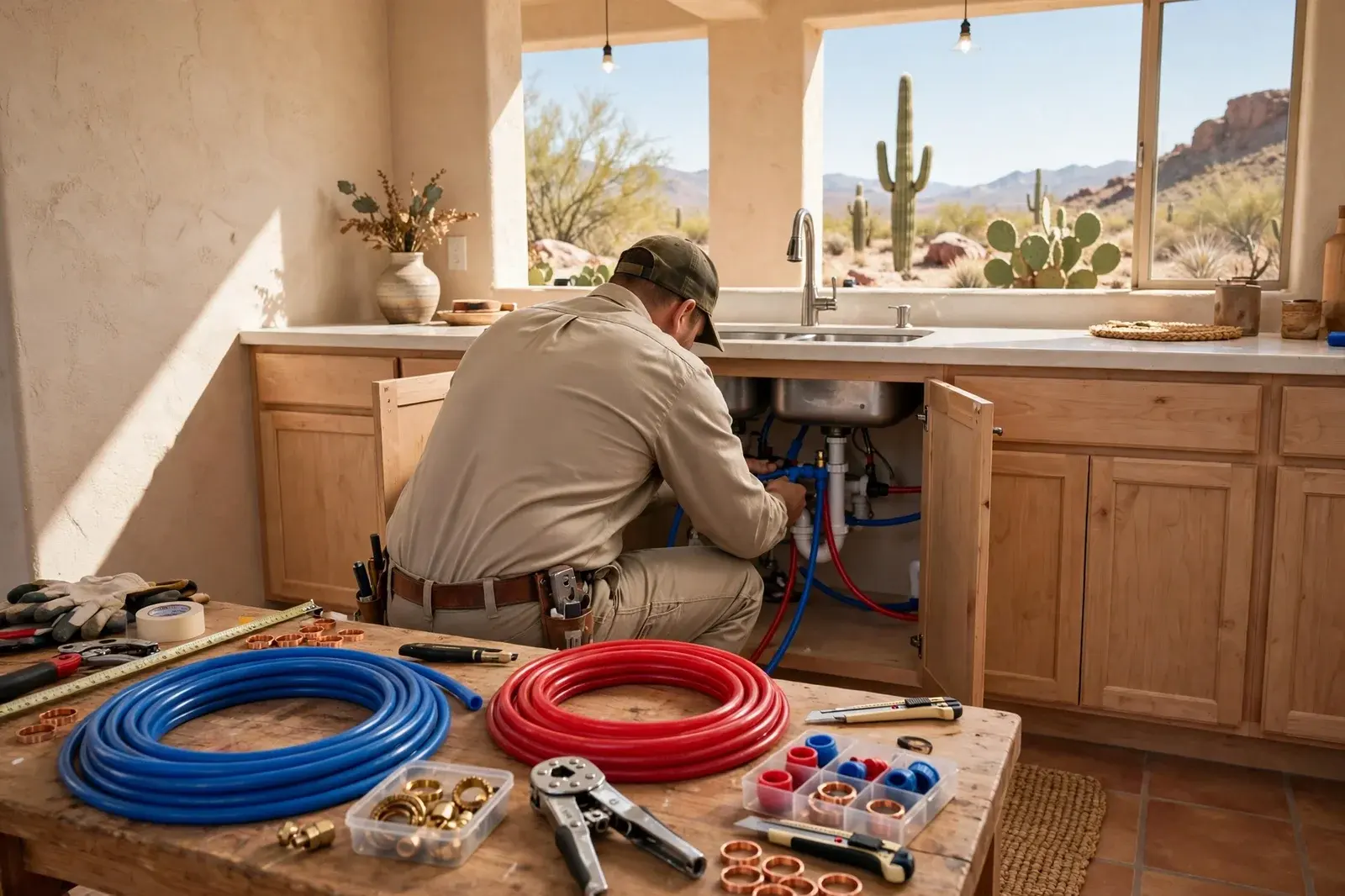
An inspection in Phoenix looks at more than the pipes. The crew checks the main shutoff, the pressure regulator, and the water heater connections, because those are often as old as the pipes and just as likely to fail.
A seized shutoff or a drifting regulator is fixed as part of the job.
After the inspection, the homeowner has the map, the pressure readings, and the written quote. If the pipes test well, the crew will say so, and a repipe may not be needed at all.
The inspection is how the homeowner finds out which case it is, before spending anything.
A water test is part of the inspection visit in Phoenix, not an extra. The crew can say whether PEX or copper suits the home's water.
With about 1,673,164 residents, Phoenix is one of the larger cities in Arizona where repiping is available, and the local company serves the whole city.
Repiping in Phoenix
Why waiting costs more in Phoenix
A small leak is cheap to ignore and expensive to live with. Water from a pinhole leak soaks framing, subfloor and drywall for weeks before anyone sees it, and by then the repair is a repipe plus carpentry.
In Phoenix, where many homes still run their original pipes, one leak is often the first of several.
Each month of waiting adds risk without adding value. The repipe costs the same next year, but the water damage, the mould risk and the emergency call-out do not.
If the pipes have leaked more than once, the cheaper path is usually to replace them before the next leak.
Delaying a repipe rarely saves money. The pipe keeps aging, and the next leak is usually bigger than the last one.
With about 1,673,164 residents, Phoenix is one of the larger cities in Arizona where repiping is available, and the local company serves the whole city.
Repiping in Phoenix
Polybutylene pipes in Phoenix homes
Polybutylene is a grey plastic supply pipe fitted in many homes built from the late 1970s to the mid-1990s. In Phoenix, homes of that age should be checked for it: look for grey plastic pipe near the water heater or under sinks, often stamped PB2110.
The replacement is a standard repipe: new PEX or copper through the same routes, a pressure test, and an inspection. The cost is usually $5,000 to $15,000 depending on the home, as a typical range and an estimate only.
If the home in Phoenix was built from the late 1970s to the mid-1990s, the pipe near the water heater will show whether it is polybutylene.
Phoenix has about 1,673,164 residents, and the repipe coverage here runs to 76 ZIP codes across Maricopa County.
Repiping in Phoenix
Pinhole leaks and slab leaks in Phoenix
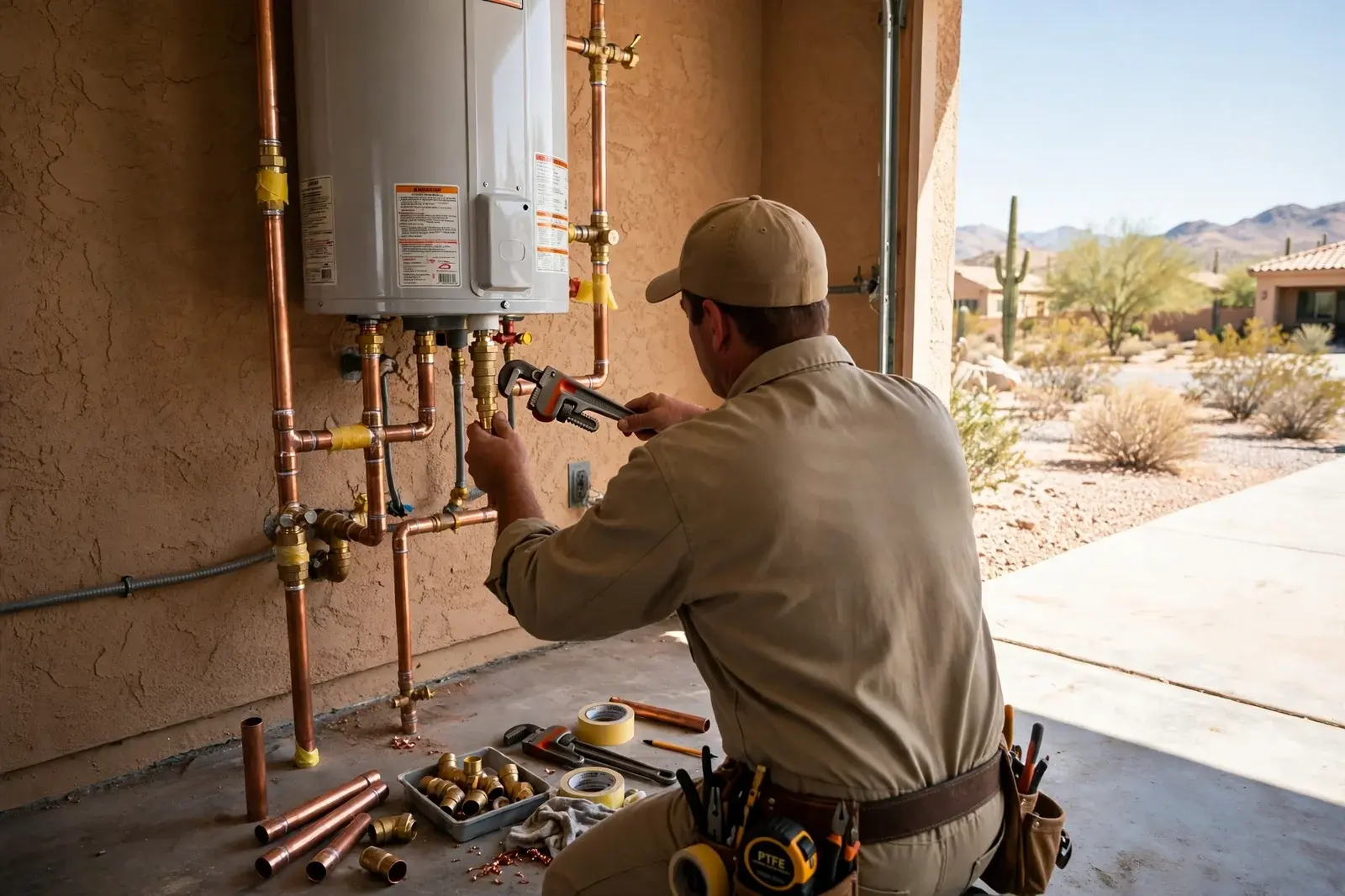
A slab leak in Phoenix is sometimes found by the floor, not by the meter. A warm spot on the floor, a tile that has lifted, or carpet that is damp in one place can all point to a leak under the concrete.
The crew confirms it with acoustic equipment and a pressure test before any floor is opened.
A repipe solves it by taking the water lines out of the slab for good. New PEX or copper runs overhead, where a leak — if one ever happens — is visible and reachable.
The crew caps the old slab lines and leaves them in place.
The lasting fix for a slab leak is a repipe that moves the lines out of the slab, usually through the attic or walls.
The service area in Phoenix covers 76 ZIP codes, from 85001 to 85098, all inside Maricopa County.
Repiping in Phoenix
Repiping and your water heater in Phoenix?
The water heater is part of the repipe map, not an afterthought. The crew looks at where it sits, how the hot lines leave it, and whether the shutoff and the pressure relief work.
A heater that is undersized for the home will still leave the showers cold, whatever the pipes do.
A heater that is more than ten years old deserves a look during the inspection. The crew can say how much life it has left and whether replacing it with the repipe saves money against doing it later as a separate job.
If the heater is replaced during the repipe in Phoenix, the new one is connected to the new lines and tested at every fixture.
The homes in Phoenix, Arizona span 76 ZIP codes, and the local company confirms coverage by ZIP before booking.
Repiping in Phoenix
Rusty or brown water in Phoenix
Homeowners in Phoenix sometimes live with brown water for years, treating it as a quirk. It is a warning.
The rust that colours the water is the pipe wall itself wearing away, and a wall that thin eventually leaks.
A repipe only fixes the first one, but it is the common one in older homes. New PEX or copper removes the rust source entirely, and the water clears for good.
After a repipe in Phoenix, the water runs clear and the aerators stop clogging with flakes. The pressure usually improves at the same time.
The homes in Phoenix, Arizona span 76 ZIP codes, and the local company confirms coverage by ZIP before booking.
Repiping in Phoenix
What happens during a repipe in Phoenix?
The repipe process in Phoenix follows the same shape in most homes. First, a pressure test and a look at the pipes.
Second, a written quote with the material, the areas covered and the patching scope. Third, the install — new lines, new valves, and a test at every fixture.
Then comes the rough-in inspection, then patching and a final walkthrough. The homeowner checks every tap, toilet and shower with the crew before signing off.
The whole job, patching included, usually wraps up inside a week.
Before the crew arrives, the homeowner clears access to every fixture the job touches. The crew confirms where it needs access on the first visit.
Phoenix sits in Maricopa County, and the 76 ZIP codes covered here run from 85001 to 85098.
Repiping in Phoenix, AZ, reaches 76 ZIP codes across Maricopa County. The city has about 1,673,164 residents, and the local plumbing company covers the full area.
The first step is the same everywhere in the city: an inspection and a written quote.
Repiping in Phoenix
How much does repiping cost in Phoenix?
Repiping a home in Phoenix is priced by the job, not by the foot, because every home's pipe layout is different. As a guide, most whole-home repipes fall between $4,500 and $12,000 for PEX and $8,000 and $20,000 for copper.
Homes with a slab foundation, where pipes are rerouted through the attic, tend toward the higher end.
Treat every number as a typical range and an estimate only. The final price depends on access, fixture count and the state of the walls.
The local plumbing company sets its own pricing after an inspection, and that written quote is what counts.
A repipe is a large job, and the quote should be read carefully before anything is agreed. The material, the rooms, and the patching should all be listed.
In Phoenix, about 1,673,164 people live across 76 ZIP codes in Maricopa County, and the local company covers all of them.
Repiping in Phoenix
After the repipe: what changes in Phoenix homes
Life after a repipe in Phoenix is mostly the absence of problems. Taps run clear, pressure holds when two showers run at once, and the water heater does not have to fight narrowed pipes.
The new shutoff valves at each fixture make future repairs easy.
In the weeks after, the water may taste slightly different if PEX was used; flushing clears it. Copper should taste the same as before.
Any new noise, drip or pressure change is worth a call back to the company while the work is under warranty.
New shutoff valves at each fixture make future repairs easy in Phoenix. A leak can be stopped at one tap instead of at the main.
Phoenix sits in Maricopa County, and the 76 ZIP codes covered here run from 85001 to 85098.
Repiping in Phoenix
Soil and ground movement under Phoenix homes
Where pipe meets soil, corrosion can work from the outside in, especially on older steel. A line buried without protection rusts faster than one in a dry wall.
During a repipe in Phoenix, the new lines run above ground, through the attic or walls, so soil no longer touches them. The old buried lines are drained, capped, and left in place.
Ground movement shows up as a warm spot, a lifted tile, or damp carpet, and the crew confirms it before any floor is opened.
About 1,673,164 people live in Phoenix, and every one of the 76 covered ZIP codes is served from Maricopa County.
Repiping in Phoenix
PEX or copper: what fits Phoenix homes?
Choosing between PEX and copper in Phoenix is not a test with one right answer. PEX is plastic pipe that bends, resists scale and costs less; copper is metal pipe that lasts longer and handles heat.
Both are approved for drinking water when certified, and both are installed by the same licensed crews.
The practical difference is price and time: PEX usually saves a few thousand dollars and a day of work. The durability difference is real but small over a normal stay in a home.
The quote should show both options so the choice is yours.
Copper costs more up front and lasts longer. PEX costs less and installs faster.
The written quote in Phoenix should show both, so the decision is the homeowner's.
Repiping in Phoenix covers the whole city — about 1,673,164 residents and 76 ZIP codes in Maricopa County.
Repiping in Phoenix
Galvanized pipe in older Phoenix homes
Older homes in Phoenix often carry their original galvanized pipes, and the pipe tells its age in the water. Brown or rusty water, especially after the taps have sat overnight, is rust flaking off the inside of the steel.
Low pressure at several taps at once is the same story: the bore has narrowed.
If the meter moves, water is going somewhere it should not. The crew then finds the leak by listening and by testing, and the fix is usually a replacement rather than a patch, because the rest of the system is the same age and the same material.
The old steel is capped and left in place after a repipe in Phoenix, since pulling it out would open far more wall than the job needs.
With about 1,673,164 residents, Phoenix is one of the larger cities in Arizona where repiping is available, and the local company serves the whole city.
Repiping in Phoenix
Freeze risk for pipes in Phoenix
The first defence against a freeze in Phoenix is knowing where the main shutoff is. If a pipe splits, the water must be stopped at the main within minutes, and the shutoff is usually near where the water line enters the home.
PEX handles a freeze better than copper or steel, because it can expand slightly without splitting. A repipe does not make pipes freeze-proof, but it makes them more forgiving, and the crew will point out any runs that need insulation.
Knowing where the main shutoff is matters most in a freeze. The crew in Phoenix shows the homeowner where it is on the first visit.
The service area in Phoenix covers 76 ZIP codes, from 85001 to 85098, all inside Maricopa County.
Repiping in Phoenix
Low water pressure in Phoenix: pipes or something else?
Before blaming the pipes, a Phoenix homeowner can check three things: the aerators on the taps, the main shutoff valve, and the pressure regulator near the main. A shutoff that is not fully open or a regulator set too low will starve the whole home.
If those check out and the pressure is still weak everywhere, the pipes are the likely cause. Galvanized steel narrows with rust; polybutylene and old copper scale up too.
A repipe restores the full bore and the pressure with it.
If only one tap is weak in a Phoenix home, the cause is usually local — a clogged aerator or a single valve — and a repipe is not needed.
The service area in Phoenix covers 76 ZIP codes, from 85001 to 85098, all inside Maricopa County.
Repiping in Phoenix
Permits and inspections for repiping in Phoenix
Repiping is not a job to do without a permit in most cities. The permit covers the rough-in inspection, which happens after the new pipes are in and before the drywall goes back.
The inspector checks that the pipe is supported, the joints are sound and the system holds pressure.
If anything needs fixing, it is fixed while the walls are still open — which is the point of inspecting at that stage. The local company handles the scheduling, and the homeowner does not need to be present, though many choose to be.
The permit, the inspection result, and the warranty go with the home's records, and they answer the first question a buyer asks about the plumbing.
The homes in Phoenix, Arizona span 76 ZIP codes, and the local company confirms coverage by ZIP before booking.
Repiping in Phoenix
Water hardness in Phoenix: what it does to pipes
Hard water does not damage PEX the way it damages metal pipe, and that is one reason PEX is common in repipes in Phoenix. Copper scales too, though more slowly than steel.
A repipe does not change the water itself, but new PEX stays clear of scale longer than metal pipe, and new copper starts clean. The crew can test the water during the inspection and say whether a softener is worth it.
New PEX stays clear of scale longer than metal pipe, and that is one reason it is common in repipes in Phoenix.
Phoenix has about 1,673,164 residents, and the repipe coverage here runs to 76 ZIP codes across Maricopa County.
Repiping in Phoenix
Your water utility and shutoff in Phoenix
The main shutoff is usually near where the water line enters the home — often in a garage, a basement, or a utility closet — and it is a lever or a round handle on the largest pipe.
The utility is not involved in a repipe, since the work is on the homeowner's side of the meter. The permit and the inspection are with the city building department, not the water company.
The water is shut off at the main during working hours and restored each evening, and the crew gives the plan each morning.
The service area in Phoenix covers 76 ZIP codes, from 85001 to 85098, all inside Maricopa County.
Signs you may need repiping
- Sweating or dripping joints in a basement are a leak in progress
- Repeat leaks on the same line mean the pipe wall is failing
- Dull grey magnetic pipe with threaded joints (galvanized steel)
- A main shutoff valve that no longer turns or seals
- A split pipe after a freeze is a sign the system is past its life
- Water that smells metallic or tastes of rust
- Rust flakes clogging tap aerators again and again
- A slow-filling appliance with clean filters points to narrowed supply lines
- Insurers ask about polybutylene because of its failure record
- Hot water running out fast can mean scaled-up hot lines
How it works
- 1
Step 1 — Inspection and pressure test
The crew checks the pressure, identifies the pipe material and maps every run before any wall is opened.
- 2
Step 2 — Confirm the scope
PEX and copper are both priced on the quote, so the homeowner can compare the two before choosing.
- 3
Step 3 — Cap the old pipe
The crew runs new PEX or copper along the planned routes, fits new valves at each fixture, and caps the old lines.
- 4
Step 4 — Test every fixture
The system is pressure-tested, the inspector checks the rough-in, and the walls are patched and cleaned up.
- 5
Step 5 — Drywall patching
Openings are patched, taped, and sanded. The quote says whether texture and paint are included.
- 6
Step 6 — Test everything, then sign off
The homeowner runs every tap with the crew, and the permit number, inspection result, and warranty are left with the home's records.
Repiping cost in Phoenix
What does it cost?
These are typical national ranges, shown as estimates only. A written quote after the inspection is what counts — it reflects the home, not the average.
| Service | Typical range (estimate) | Notes |
|---|---|---|
| Whole-home repipe (PEX) | $4,500 – $12,000 | Most 2–3 bed homes |
| Whole-home repipe (copper) | $8,000 – $20,000 | Longer-lasting metal pipe |
| Partial repipe (one area) | $2,000 – $6,000 | One bathroom or hot lines |
| Polybutylene replacement | $5,000 – $15,000 | Full grey-pipe swap |
| Galvanized pipe replacement | $5,000 – $15,000 | Old steel out, new pipe in |
| Pressure test & pipe inspection | $150 – $400 | Standalone visit |
Prices are estimates only. The local company that does the work sets its own final pricing.
Questions about repiping in Phoenix