
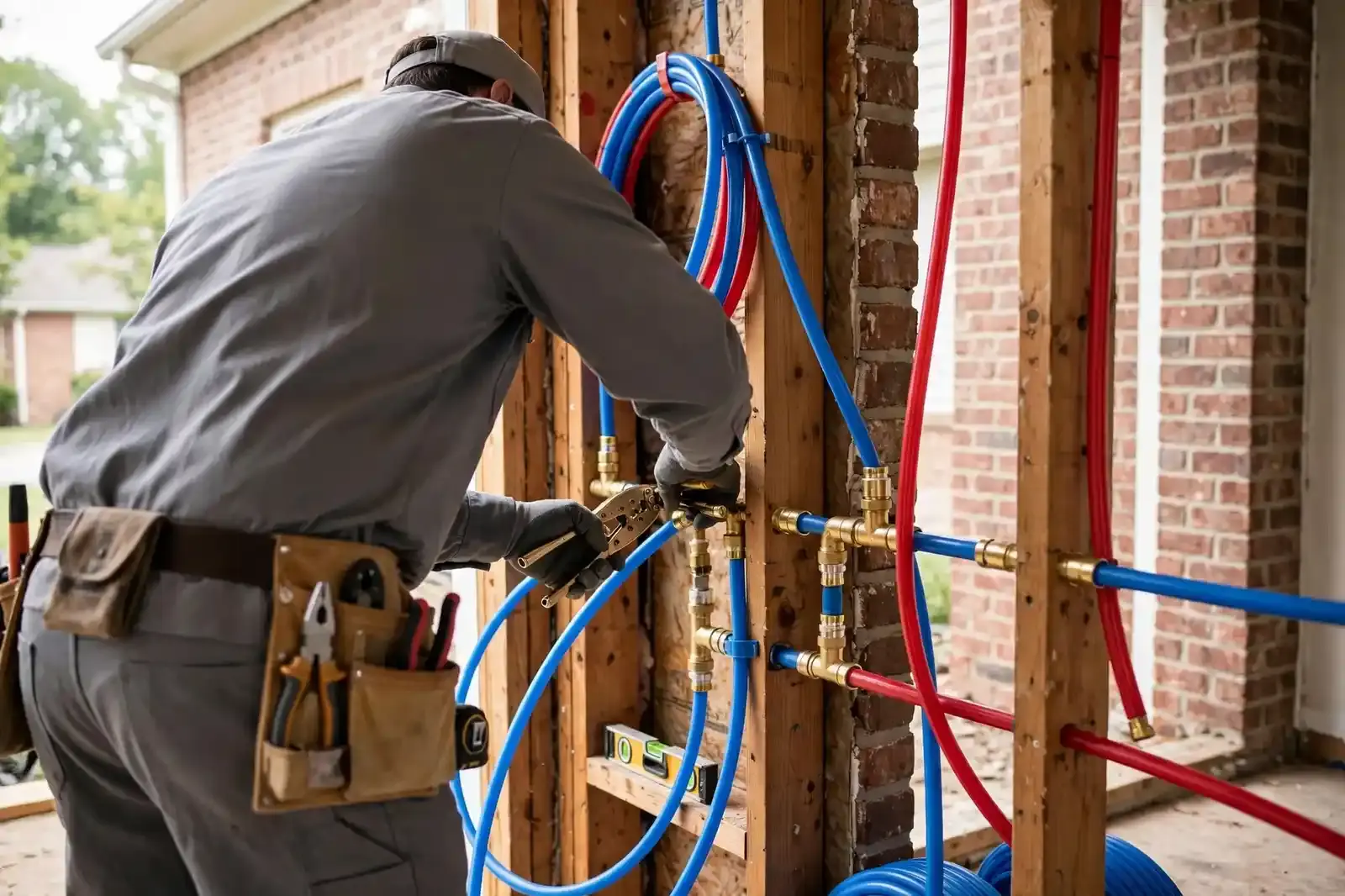
Repiping in Raleigh, NC
Repiping a home in Raleigh replaces the water supply pipes with new PEX or copper, room by room, over a few days. The water is restored each evening, and the walls are patched after the inspection passes. Call (833) 878-1592 to talk it through with a local plumbing company.
Updated 2026-11-18. Raleigh, NC · Wake County · Population 499,825. Prices shown are estimates only.
- 499,825 Population
- Wake County
- 44 ZIP codes served
Before & after in Raleigh
Before & after
Drag the slider to compare the same spot before and after the repair.
Repiping in Raleigh
How long does a repipe take in Raleigh?
The repipe clock in Raleigh starts with the inspection and the permit, which the company handles. The physical work — the part the homeowner sees — is usually two to five days.
A partial repipe is often one or two days.
The water shutoff is the part people worry about most, and it is limited: off during the working day, back on in the evening. The crew gives a shutoff plan each morning.
A small home with open access can finish in two days in Raleigh. A larger home, or one with pipes through finished walls, takes longer.
Repiping in Raleigh covers the whole city — about 499,825 residents and 44 ZIP codes in Wake County.
Repiping in Raleigh
Galvanized pipe in older Raleigh homes

Galvanized pipe fails slowly and then all at once. For decades the rust builds up inside, narrowing the bore until the shower runs weak and the washing machine fills slowly.
Then a section rusts through and leaks.
Replacement is the only lasting fix, and it is a standard job: new PEX or copper through the same routes, new shutoff valves at each fixture, and a pressure test at the end. Most homes finish in two to five days.
There is no cleaning that restores galvanized pipe. The wall is thin and rusted, and the fix is a repipe with PEX or copper.
About 499,825 people live in Raleigh, and every one of the 44 covered ZIP codes is served from Wake County.
Repiping in Raleigh
Repiping and your water heater in Raleigh?
The water heater is part of the repipe map, not an afterthought. The crew looks at where it sits, how the hot lines leave it, and whether the shutoff and the pressure relief work.
A heater that is undersized for the home will still leave the showers cold, whatever the pipes do.
If the heater is replaced during the repipe, the new one is connected to the new lines and tested at every fixture. The old heater is removed, and the new shutoff valves make the next replacement easy.
The heater replacement is listed separately on the quote.
A heater that is undersized will still leave showers cold, whatever the pipes do, and the crew in Raleigh will say so plainly.
The service area in Raleigh covers 44 ZIP codes, from 27601 to 27699, all inside Wake County.
Repiping in Raleigh
Your water utility and shutoff in Raleigh
During a repipe in Raleigh, the water is shut off at the main during working hours and restored each evening. The crew tells the household the shutoff plan each morning, so nobody is caught by surprise.
The utility is not involved in a repipe, since the work is on the homeowner's side of the meter. The permit and the inspection are with the city building department, not the water company.
The utility owns the line up to the meter, and the homeowner owns the pipes from the meter into the house.
In Raleigh, about 499,825 people live across 44 ZIP codes in Wake County, and the local company covers all of them.
Repiping in Raleigh
Polybutylene pipes in Raleigh homes

Polybutylene looks harmless — smooth grey plastic — but it has a known weakness. The chlorine used to treat drinking water makes it brittle over time, and joints can let go suddenly.
In Raleigh, homes with this pipe are usually advised to replace it before it fails rather than after.
A replacement job swaps the grey plastic for PEX or copper, usually in two to five days. Some insurers and buyers treat polybutylene as a defect, so replacing it also helps when the home is sold.
The local company can confirm the pipe type in a single visit.
Grey plastic pipe in a Raleigh home is worth checking, even if it has never leaked. The failure, when it comes, is sudden and the water release is large.
Repiping in Raleigh covers the whole city — about 499,825 residents and 44 ZIP codes in Wake County.
Repiping in Raleigh
Rusty or brown water in Raleigh
Rusty water in a Raleigh home has two sources, and telling them apart matters. Water that runs brown after sitting overnight and clears after a minute points to rusting pipes inside the home — usually galvanized steel.
Water that is brown at every tap all day, including the neighbours', points to the supply.
If the colour comes from the city supply, the neighbours see it too and it does not clear with running. A repipe fixes the home's side of the problem: new PEX or copper has nothing to rust, so the water runs clear from the first glass.
A filter catches the flakes but leaves the thinning pipe in the wall. PEX or copper has no rust to shed, so the water stays clear.
Raleigh sits in Wake County, and the 44 ZIP codes covered here run from 27601 to 27699.
Repiping in Raleigh
PEX or copper: what fits Raleigh homes?
The water in Raleigh can tip the choice. Hard water leaves scale on metal pipe and narrows the bore over time, while PEX stays clear.
Aggressive water can pit copper and cause pinhole leaks. The installer can look at the water and the old pipes and say which material suits the home.
Some homes mix the two: PEX for the long runs, copper where it shows or where heat is highest. The local plumbing company can explain the mix and price each version.
Either way, the new pipe is a large step up from galvanized steel or polybutylene.
Hard water leaves scale on metal pipe and narrows the bore over time, while PEX stays clear. The installer in Raleigh can look at the water and advise.
The homes in Raleigh, North Carolina span 44 ZIP codes, and the local company confirms coverage by ZIP before booking.
Repiping in Raleigh, NC, reaches 44 ZIP codes across Wake County. The city has about 499,825 residents, and the local plumbing company covers the full area.
The first step is the same everywhere in the city: an inspection and a written quote.
Repiping in Raleigh
What happens during a repipe in Raleigh?
A repipe in Raleigh starts with a visit: the crew tests the water pressure, finds the pipe material, and maps the runs from the main to every fixture. That map becomes the plan — which walls open, where the new lines run, and where the water is shut off each day.
During the work, the crew checks in each morning with the shutoff plan for the day, so the household knows when the water will be off and when it will be back. The homeowner checks the work at each stage, and the final walkthrough covers every tap, toilet, and shower.
A repipe in Raleigh is a planned job, not an emergency. The crew works to a schedule, and the homeowner knows each day what will happen and when.
About 499,825 people live in Raleigh, and every one of the 44 covered ZIP codes is served from Wake County.
Repiping in Raleigh
What does a repipe inspection find in Raleigh?
The inspection in Raleigh also looks at the water itself. Hard water, aggressive water, and high pressure all shape the material choice, and the crew can say whether PEX or copper suits the home's water before quoting.
A water test is part of the visit, not an extra.
The inspection ends with a written quote: the material, the areas covered, the permit, the inspection, the patching, and the warranty. The homeowner keeps the quote and decides in their own time.
There is no charge for the call that books the visit.
Keep the inspection result with the permit number and the warranty. In Raleigh, that paperwork is what a buyer or an insurer asks for first.
Repiping in Raleigh covers the whole city — about 499,825 residents and 44 ZIP codes in Wake County.
Repiping in Raleigh
Why waiting costs more in Raleigh
Pipes do not heal, and in Raleigh the older the system the faster the failures come. Galvanized pipe rusts from the inside, copper pits, and polybutylene can split with little warning.
The first leak is a warning; the second is a pattern.
The other cost of waiting is the sale. A buyer who finds old pipes during an inspection will ask for a credit or a replacement, and the negotiation happens on the buyer's terms.
A planned repipe, done before listing, takes that demand off the table.
Delaying a repipe rarely saves money. The pipe keeps aging, and the next leak is usually bigger than the last one.
Raleigh sits in Wake County, and the 44 ZIP codes covered here run from 27601 to 27699.
Repiping in Raleigh
Low water pressure in Raleigh: pipes or something else?
In Raleigh, low pressure that affects the whole home is rarely a single fixture. It is the system: old pipes narrowed by rust or scale, a pressure regulator that has drifted, or a main valve that no longer opens fully.
The regulator and valve are cheap checks. The pipes are the expensive one, but they are also the common one in homes with original galvanized lines.
A pressure test and a look at the pipe material settle it before any wall is opened.
Low pressure that affects the whole home in Raleigh is rarely a single fixture. It is the system, and the inspection finds which part of it.
In Raleigh, about 499,825 people live across 44 ZIP codes in Wake County, and the local company covers all of them.
Repiping in Raleigh
Soil and ground movement under Raleigh homes
Where pipe meets soil, corrosion can work from the outside in, especially on older steel. A line buried without protection rusts faster than one in a dry wall.
During a repipe in Raleigh, the new lines run above ground, through the attic or walls, so soil no longer touches them. The old buried lines are drained, capped, and left in place.
New lines run above ground after a repipe in Raleigh, so soil no longer touches them and they can be inspected and repaired.
Raleigh has about 499,825 residents, and the repipe coverage here runs to 44 ZIP codes across Wake County.
Repiping in Raleigh
Water hardness in Raleigh: what it does to pipes
Hard water does not damage PEX the way it damages metal pipe, and that is one reason PEX is common in repipes in Raleigh. Copper scales too, though more slowly than steel.
If the water is very hard, the new pipes will scale up more slowly than the old ones, but a softener is still the fix for hard water itself. The repipe and the softener are two different jobs, and the crew will say so plainly.
A softener removes the minerals before they reach the pipes, and the repipe and the softener are two different jobs.
The homes in Raleigh, North Carolina span 44 ZIP codes, and the local company confirms coverage by ZIP before booking.
Repiping in Raleigh
Freeze risk for pipes in Raleigh
The first defence against a freeze in Raleigh is knowing where the main shutoff is. If a pipe splits, the water must be stopped at the main within minutes, and the shutoff is usually near where the water line enters the home.
New PEX lines reduce the risk, and insulation removes most of what is left. The inspection notes which runs are exposed, and the crew plans around them.
Knowing where the main shutoff is matters most in a freeze. The crew in Raleigh shows the homeowner where it is on the first visit.
Raleigh has about 499,825 residents, and the repipe coverage here runs to 44 ZIP codes across Wake County.
Repiping in Raleigh
How much does repiping cost in Raleigh?
For a home in Raleigh, Wake County, the usual whole-home repipe range is $4,500 to $12,000 in PEX and $8,000 to $20,000 in copper. A partial repipe — one bathroom group, or the hot-water lines only — usually runs $2,000 to $6,000.
A pressure test and pipe inspection on its own is typically $150 to $400.
Ask the local company to show the quote in writing with the material named, not just a price. PEX and copper should both be priced, so the choice is yours.
If the two prices are close, the dearer material may be worth it; if they are far apart, the cheaper one usually is.
Budget for the quote, not for the average. The average is a guide; the quote is the price for this home, in Raleigh, with its own pipes and layout.
In Raleigh, about 499,825 people live across 44 ZIP codes in Wake County, and the local company covers all of them.
Repiping in Raleigh
Pinhole leaks and slab leaks in Raleigh
In Raleigh, a home that has had two slab leaks has a system problem, not two accidents. The pipes under the slab are the same age and the same material, and they are failing in turn.
Each repair breaks flooring and costs a visit.
The fix that lasts is a reroute: new lines through the attic or walls, with the old slab lines capped and left in place. Breaking the slab to patch one spot leaves the rest of the old line under the floor, and a home that has had one slab leak often has more coming.
When pinholes repeat in Raleigh, the system is the problem, not the spot. A repipe takes the old copper out of service and ends the cycle.
The homes in Raleigh, North Carolina span 44 ZIP codes, and the local company confirms coverage by ZIP before booking.
Repiping in Raleigh
Permits and inspections for repiping in Raleigh
A repipe permit in Raleigh is usually a simple plumbing permit, and the plumbing company deals with it. The homeowner's part is small: confirm the permit is filed, keep the number, and be available for the inspection if the company asks.
If anything needs fixing, it is fixed while the walls are still open — which is the point of inspecting at that stage. The local company handles the scheduling, and the homeowner does not need to be present, though many choose to be.
Ask for the permit number before work starts in Raleigh, so it can be checked with the city building department.
Raleigh sits in Wake County, and the 44 ZIP codes covered here run from 27601 to 27699.
Repiping in Raleigh
After the repipe: what changes in Raleigh homes
A repiped home in Raleigh feels different at the taps: full pressure, clear water, and hot water that arrives faster because the new lines are sized and routed properly. The change is most obvious in homes that lived with galvanized pipe for years.
The walls are patched and painted, and the only sign of the work is the paperwork: the permit, the inspection result and the warranty. Keep those with the home's records — a buyer will ask for them.
Showers run stronger, the washing machine fills faster, and the hot water arrives sooner after a repipe in Raleigh.
Repiping in Raleigh covers the whole city — about 499,825 residents and 44 ZIP codes in Wake County.
Signs you may need repiping
- Sweating or dripping joints in a basement are a leak in progress
- A slab that feels warm in one spot, or flooring that is damp
- Brown water after time away means rust built up while the taps sat
- Low water pressure at several taps at once
- Grey plastic pipe by the heater is often polybutylene and worth checking
- Lead pipe or lead solder found during other work
- A pipe that has frozen and split in a cold snap
- Rust flakes clogging tap aerators again and again
- Insurers ask about polybutylene because of its failure record
- A musty smell near a wall where a pipe runs
How it works
- 1
Step 1 — Check the pipes first
The crew looks at the exposed pipe near the heater and the main to find whether it is steel, plastic, or copper.
- 2
Step 2 — Agree the price in writing
The local company quotes the job in writing — material, areas covered, patching and warranty — and files the plumbing permit.
- 3
Step 3 — Install the new lines
Each fixture gets a new shutoff valve as the new lines go in, so future repairs are easy.
- 4
Step 4 — Clean up each day
A pressure test and the rough-in inspection come before the walls are patched and the home is cleaned.
- 5
Step 5 — Repair the openings
The crew patches each opening, sands it smooth, and cleans the room before moving on.
- 6
Step 6 — Final walkthrough and paperwork
The final walkthrough covers every tap and toilet, and the permit, inspection result, and warranty are left with the homeowner.
Repiping cost in Raleigh
What does it cost?
These are typical national ranges, shown as estimates only. A written quote after the inspection is what counts — it reflects the home, not the average.
| Service | Typical range (estimate) | Notes |
|---|---|---|
| Whole-home repipe (PEX) | $4,500 – $12,000 | Most 2–3 bed homes |
| Whole-home repipe (copper) | $8,000 – $20,000 | Longer-lasting metal pipe |
| Partial repipe (one area) | $2,000 – $6,000 | One bathroom or hot lines |
| Polybutylene replacement | $5,000 – $15,000 | Full grey-pipe swap |
| Galvanized pipe replacement | $5,000 – $15,000 | Old steel out, new pipe in |
| Pressure test & pipe inspection | $150 – $400 | Standalone visit |
Prices are estimates only. The local company that does the work sets its own final pricing.
Questions about repiping in Raleigh