
Galvanized Pipe Replacement Guide
Galvanized steel pipe was the standard before the 1970s, and most of it is past its working life now. This guide explains how to identify it, why it fails, what replacement involves, what it costs, and which material replaces it best.
Updated 2026-11-18. Prices shown are estimates only.
What galvanized pipe is
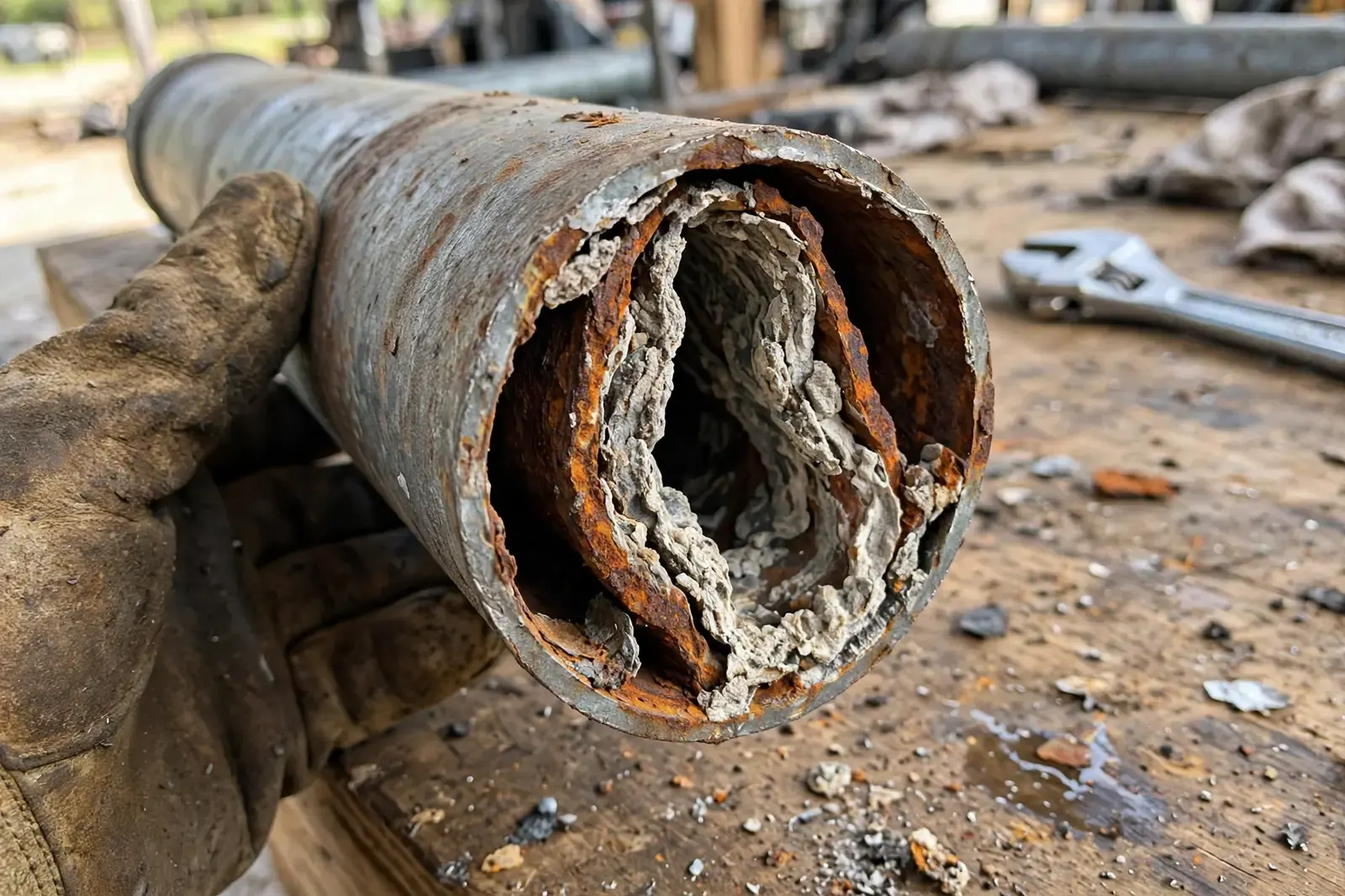
Galvanized pipe is steel pipe coated with zinc, used in most homes built before the 1970s. The zinc was meant to protect the steel from rust. It wears away over decades, the steel rusts, and the inside of the pipe narrows year by year until pressure drops and water turns brown. It is dull grey, magnetic, and joined with threaded fittings.
Galvanized pipe has a working life of roughly 40 to 60 years, and most of it is past that now. The narrowing is why it cannot be fixed by cleaning: the pipe wall itself is the problem. Replacement with PEX or copper restores full flow and clear water, and it ends the leak cycle at the threaded joints.
How to tell if your home has it
If the home was built before 1970 and still has its original pipes, they are almost certainly galvanized steel. Look at an exposed pipe in the basement, the crawl space, or near the water heater: dull grey, magnetic, with threaded fittings. A magnet sticks to it, and a scratch shows silver-grey metal.
The signs in use are just as clear. Weak pressure at every tap at once, brown water first thing in the morning, rust flakes in the aerators, and a washing machine that fills slowly with clean filters. Cut out a section and look inside: a healthy pipe has a clean bore, while a galvanized pipe at the end of its life is choked with rust.
Why galvanized pipe fails the way it does
Galvanized pipe fails slowly and then all at once. For decades the rust builds up inside, narrowing the bore until the shower runs weak and the washing machine fills slowly. Then a section rusts through, or a threaded joint lets go. The pipe that bursts is not the exception; it is the first of the system to reach the end.
The threaded joints are the weak point. The threads rust, and when a joint goes the water is under full pressure and the leak is inside the wall or under the floor. Patching a burst galvanized pipe means joining new pipe to rusted threads, and the next joint is already thin.
What replacement involves
The crew maps the system first, then replaces the lines in sections, testing as it goes. Old galvanized lines are heavy and threaded, so they are cut out in pieces rather than pulled. The new PEX or copper runs beside them or through new routes, often through the attic in homes where the old pipes ran under the slab.
The old steel is capped and left in the walls, since removing it would mean opening far more wall. The work takes two to five days for most homes, with water off only during working hours. The system is pressure-tested, the inspector checks the rough-in, and the walls are patched.
PEX or copper as the replacement
PEX is the usual replacement for galvanized pipe. It costs less, installs faster, and its smooth walls do not collect scale, so the pressure stays up. A PEX replacement usually runs $4,500 to $12,000 for a whole home. Copper is the longer-life option at 50 to 70 years, at $8,000 to $20,000.
Either way, the new pipe is a large step up from galvanized steel. The crew also fits new shutoff valves at each fixture and usually fits a new main shutoff, since the old one is as old as the pipes. The water runs clear from the first glass, and the pressure usually improves at the same time.
Cost, timing and the decision
Replacing galvanized pipe usually runs $5,000 to $15,000 for a whole home, depending on size, fixture count, and access. Homes with a slab foundation, where pipes are rerouted through the attic, tend toward the higher end. These are typical national ranges, shown as estimates only. The written quote follows the inspection.
The decision is usually straightforward. A galvanized system past 50 years with falling pressure and brown water is at the end of its life, and the only lasting fix is replacement. The planned job — scheduled, quoted, and done in a few days — is calmer and cheaper than the emergency job that follows a burst. Call (833) 878-1592 to book the inspection.
The bottom line on galvanized pipe
Galvanized steel pipe was the standard before the 1970s, and most of it is past its working life of 40 to 60 years now. The zinc coating is gone, the steel is rusting, and the inside bore has narrowed until pressure drops and water turns brown. The only lasting fix is replacement.
The replacement usually runs $5,000 to $15,000 for a whole home, as a typical range and an estimate only. PEX is the usual replacement material, at $4,500 to $12,000. Copper is the longer-life option, at $8,000 to $20,000. Either way, the water runs clear from the first glass, and the pressure usually improves at the same time.
A galvanized system with falling pressure and brown water is at the end of its life, and the planned replacement is calmer and cheaper than the emergency job that follows a burst. Call (833) 878-1592 to book an inspection and a written quote.
How do you read a repipe quote?
Start at the top of the quote and work down. The material should be named — PEX or copper, and the brand and system. The scope should be named too: which rooms, which fixtures, and which lines. Then the extras: the permit, the inspection, the patching, and the warranty.
A complete quote answers all of those before the homeowner asks. An incomplete quote leaves the homeowner guessing, and the guessing is where the extra bills come from. If a line is missing, ask where it is. A company that lists everything is usually the company that does everything.
What should the written quote list?
The quote should name the pipe, the rooms, and the extras. The pipe is PEX or copper, with the brand and the fitting system. The rooms are the kitchen, the bathrooms, the laundry, and the lines to the water heater. The extras are the permit, the inspection, the patching, and the warranty.
It should also show both materials priced, so the homeowner can see the gap between PEX and copper for this home, and it should state when the water is back on each day. A quote that lists all of that is a plan. A quote that lists only a price is a guess.
How long do new pipes last?
Copper lasts longer on paper: 50 to 70 years against PEX at 40 to 50. Over a normal stay in a home, that gap rarely decides anything — most homeowners move, or replace the water heater twice, before either pipe reaches the end of its life.
The warranty is the practical version of the lifespan: the pipe maker warranties the material, and the installer warranties the work, each for a stated length. Both should be in writing on the quote, with the length and what is covered, so the homeowner knows what is promised and for how long.
What is a pressure test, and why does it matter?
A pressure test is the repipe's pass-or-fail check. The new lines are filled with water and held at pressure, and the gauge must not move. If it moves, there is a leak, and the crew finds it before the drywall goes back.
The test also separates the causes of low pressure. Good pressure at the main with weak pressure at the taps means the pipes are the problem, and the test proves the new pipes have fixed it. It is a five-minute job that answers the question the whole repipe was meant to answer.
How do you choose between PEX and copper?
PEX wins on price and time. Copper wins on lifespan and heat tolerance. Both are approved for drinking water, both are installed by the same licensed crews, and both fix the same problems: repeat leaks, brown water, and low pressure.
The deciding factors are the home, the water, and the budget. Hard water favours PEX, because scale does not grip its smooth walls. A long stay favours copper, because it lasts 50 to 70 years. A tight budget favours PEX, because it usually saves a few thousand dollars. Get both prices in writing and compare them.
What happens to the old pipes?
The old lines are drained, capped, and left in the walls. Pulling them out would mean opening far more wall, and there is no need: capped pipe carries no water and cannot leak. The new PEX or copper runs beside them or through new routes.
Where the old pipe is easy to reach — in a basement, a crawl space, or an open wall — the crew may remove it. Where it is buried in a finished wall, it stays, capped and out of service. The crew removes the cut-out sections and any debris at the end of the job.
How much mess does a repipe make?
A repipe is a construction job inside a lived-in home, and it looks like one for a few days: open walls, dust sheets, and the sound of cutting. The crew keeps it contained by working room by room, sealing off the work areas, and cleaning up daily.
The water follows a schedule the crew gives each morning: off during the work, back on in the evening. The patching stage follows the inspection, and the paint and texture are finished as agreed in the quote. From the first cut to the last patch, most homes are done inside a week.
Can you stay in the home during the work?
Yes — a repipe is designed to be lived through. The crew restores the water each evening, seals off the work rooms, and protects the floors. The household stays, the job runs for a few days, and the patching follows.
If the home has a single bathroom, tell the crew before the work starts, so the shutoffs are planned around it. If anyone in the home is sensitive to dust or noise, the crew can say which days will be the loudest, so the household can plan around them.
What does the permit protect?
The permit protects the homeowner at sale time and after a claim. A buyer who sees a permit and an inspection result knows the repipe was done properly. An insurer who sees them knows the work was inspected.
Work done without a permit can be flagged in a sale, when a buyer's inspector asks for the record and there is none. Some homeowners are offered a lower price for work without a permit. That price is lower because the inspection, the paperwork, and the accountability are missing.
How do you check a plumbing company's licence?
The licence check takes a few minutes and it is worth doing. Ask the company for its licence number, then look it up with the state licensing board. The record shows whether the licence is current and what class of work it covers.
Also ask for proof of insurance, and ask for the permit number before work starts. A company that files permits, books inspections, and shows its licence is a company that can be trusted with a multi-day job inside the home.
What is the difference between a repipe and a repair?
A repair fixes one spot: one joint, one run, one fixture. A repipe replaces the system: every supply pipe in the home, or every pipe in the area being replaced. The repair is cheaper today; the repipe is cheaper over time when the system is failing.
The inspection decides which one a home needs. One leak on a young system is a repair. Three leaks in a year, or a system made of galvanized steel or polybutylene past its life, is a repipe. The quote should show both options, so the homeowner can compare them.
When is the best time to repipe?
Book the repipe when the signs say the system is failing, not when the ceiling says it has. The inspection takes one visit, and the quote follows it. The work is usually booked a few weeks out, and the crew gives a schedule before it starts.
The cost of waiting is not just money: each month of waiting adds risk without adding value, and the leak that matters arrives on its own schedule. A planned job is calmer and cheaper than the emergency job that follows a burst.
What records should you keep after the job?
Four records cover the job: the permit, the inspection result, the warranty, and the written quote. The permit and the inspection result prove the work was done to code. The warranty says what is covered and for how long. The quote says what was agreed, and what it included.
Keep them together, where the home's records are kept. The buyer's inspector will ask for the permit. The insurer will ask for the inspection result. The next plumber will ask what material is in the walls. The folder answers all three.
How do you prepare a home for a repipe?
The homeowner's part before the work starts is small: clear access, cover furniture, and keep the driveway open. Clear the areas around every fixture, the water heater, and the main shutoff, and move items away from walls where the pipes run.
The crew handles the rest: floor protection, dust sealing, and the tools. The homeowner should also know the plan for the water — when it will be off each day, and when it will be back on — so showers, laundry, and cooking can be planned around it. The crew gives that plan on the first morning.
What should you do in the first week after a repipe?
In the first week, check every tap, toilet, and shower, and look at the patching as it dries. Run each fixture and watch for drips at the new valves. If a patch cracks or a valve weeps, the crew should come back and fix it while the work is under warranty.
The water may taste slightly different after a PEX repipe; flushing the taps clears it. Copper should taste the same as before. Any new noise, drip, or pressure change is worth a call back to the company in the first week, not the first month.
Signs you may need repiping
- Brown water first thing in the morning
- Weak pressure at every tap at once
- Rust flakes clogging tap aerators
- Dull grey magnetic pipe with threaded joints
- A home built before 1970 with original pipes
- A washing machine that fills slowly with clean filters
- A pipe that has leaked twice in the same year
- Water pressure that falls when a second tap opens
How it works
- 1
Step 1 — Look before cutting
The crew checks the pressure, identifies the pipe material and maps every run before any wall is opened, so the openings stay small.
- 2
Step 2 — Quote, then permit
The quote lists the material, the scope and the patching. The company then files the permit and books the inspection.
- 3
Step 3 — Replace, room by room
The crew works room by room, replacing old lines with new PEX or copper and testing as it goes.
- 4
Step 4 — Final check and patching
Every tap is tested, the inspection is signed off, and the drywall is patched and the site cleaned.
- 5
Step 5 — Patching the walls
Drywall patching follows the pipe work, and the quote says whether texture and paint are included. The walls are closed only after the inspection passes.
- 6
Step 6 — Final walkthrough
Every tap, toilet, and shower is run with the crew before sign-off, and the permit number, inspection result, and warranty are kept with the home's records.
What does it cost?
All figures are typical national ranges, shown as estimates only. The written quote from the local company replaces them once the pipes have been inspected.
| Service | Typical range (estimate) | Notes |
|---|---|---|
| Whole-home repipe (PEX) | $4,500 – $12,000 | Most 2–3 bed homes |
| Whole-home repipe (copper) | $8,000 – $20,000 | Longer-lasting metal pipe |
| Partial repipe (one area) | $2,000 – $6,000 | One bathroom or hot lines |
| Polybutylene replacement | $5,000 – $15,000 | Full grey-pipe swap |
| Galvanized pipe replacement | $5,000 – $15,000 | Old steel out, new pipe in |
| Pressure test & pipe inspection | $150 – $400 | Standalone visit |
Prices are estimates only. The local company that does the work sets its own final pricing.