
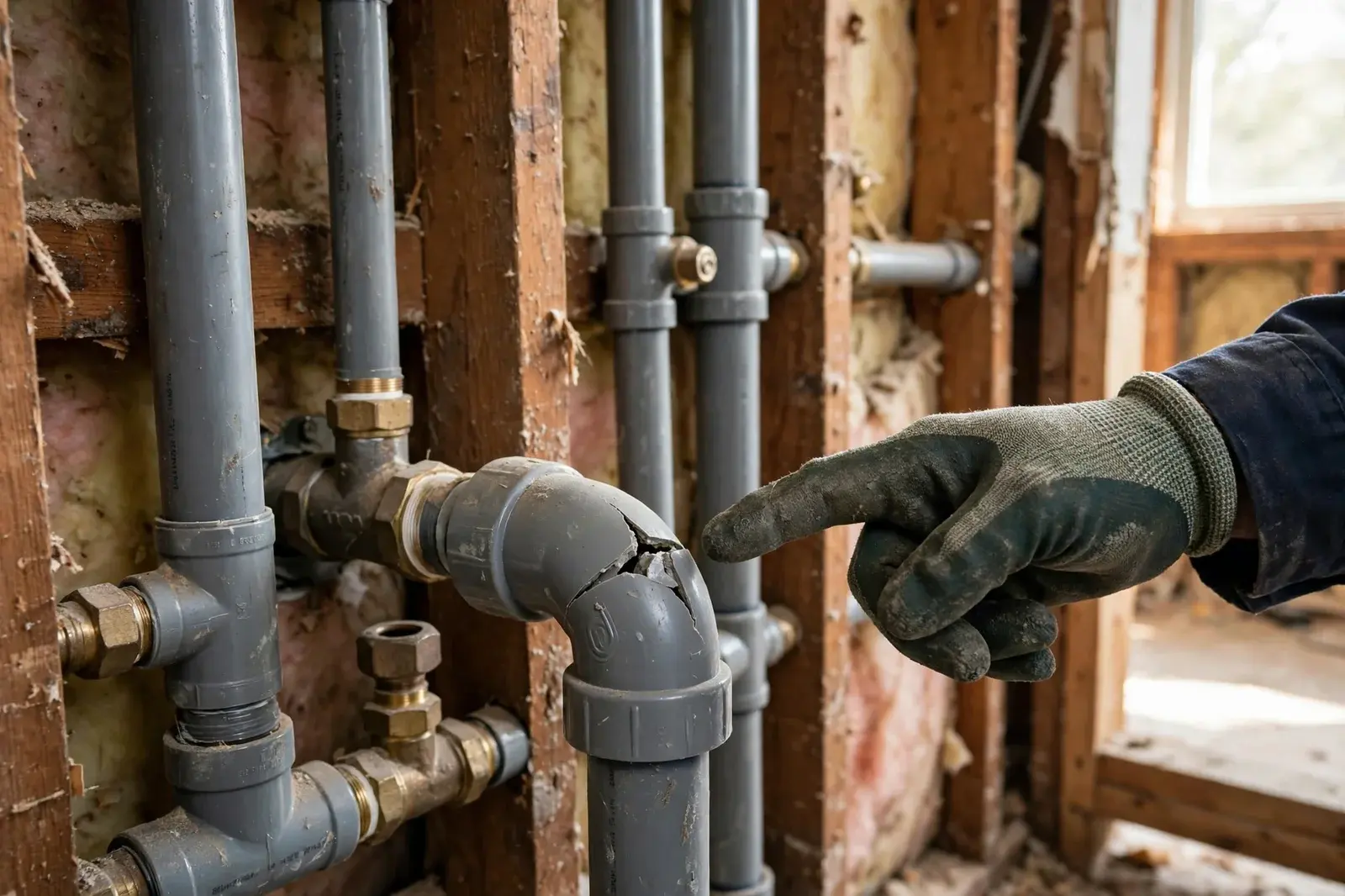
Polybutylene Pipe Replacement Guide
Polybutylene is grey plastic pipe fitted from the late 1970s to the mid-1990s, and it can fail at a fitting with no warning. This guide explains how to identify it, why it fails, what replacement costs, and what the work involves.
Updated 2026-11-18. Prices shown are estimates only.
Finding grey plastic pipe in your home
Start at the water heater. Polybutylene usually shows there first: grey, flexible plastic lines running to and from the heater, with fittings that often carry a grey or white collar. Look under sinks next, and at the main shutoff. The pipe is sometimes stamped PB2110, and that stamp settles the question on the spot.
The age of the home narrows it down. Pipe of this type went into homes from the late 1970s to the mid-1990s, so a house built in that window with its original supply lines is a candidate. Appearance alone is not proof — other grey plastic pipe exists — so the fitting type and the stamp are part of the identification, and a plumber can confirm it in a single visit.
Why insurers and buyers care about it
An insurance questionnaire will often ask what the supply pipes are made of, and polybutylene is the answer that raises the premium or the eyebrow. Some insurers charge more while it is in place; a few decline cover. The reason is the failure record: the pipe can split at a fitting with no warning, and the claim that follows is a big one.
Buyers care for the same reason. Their inspector will flag grey plastic pipe in the report, and the flag usually turns into a request: replace it, or credit the cost. Replacing it before listing takes that negotiation off the table. It is not a legal requirement in most places, but it is one of the cheaper ways to make a sale go through cleanly.
What a failure looks like
A polybutylene failure is usually sudden. The pipe goes brittle where chlorine in treated water has attacked it, and a fitting lets go — often a full split rather than a drip. The water release is large and fast, and a room can flood in minutes. The first sign is sometimes a damp patch; just as often there is no sign at all until the water is on the floor.
The damage is what makes the failure expensive, not the pipe. Flooring, drywall, and framing soak up water for hours before anyone sees it, and the cleanup costs more than the replacement would have. That is the arithmetic that pushes most homeowners from watching the pipe to replacing it.
Replacing it: the job in brief
The replacement runs like any repipe. The crew maps the system from the fixtures back to the main, then runs new PEX or copper through the same routes — walls, attic, or crawl space — and fits a new shutoff valve at each fixture. Every grey line is taken out of service, capped, and left in the walls, since pulling it out would mean opening far more wall.
Most homes finish in two to five days, with the water off only during working hours and restored each evening. The new lines are pressure-tested, the rough-in is inspected before the walls close, and the drywall is patched after. The crew also checks the water heater connections and the main shutoff, which are often as old as the pipe.
What it costs, and what the quote should show
A full swap usually runs $5,000 to $15,000, depending on the size of the home, the number of fixtures, and how easy the pipes are to reach. PEX is the usual replacement material, at $4,500 to $12,000 for a whole home. Copper is the dearer option, at $8,000 to $20,000. A partial swap — one bathroom group only — usually runs $2,000 to $6,000.
Those are typical national ranges, shown as estimates only. The written quote is what counts, and it should list the material, the areas covered, the permit, the inspection, and the patching. If the quote leaves out patching or the permit, ask: those are the items most often missing from a low figure, and they are the items that cost money later.
Replacing before you sell — or after you buy
For a seller, the case is simple: replace it, and the buyer has nothing to flag. The repipe paperwork — the permit, the inspection result, and the warranty — goes with the home's records and answers the question before it is asked. The work is done on the seller's schedule, the walls are patched and painted, and the home shows with new pipes in place.
For a buyer who has just found polybutylene in a home inspection, the same logic applies in reverse. The replacement can be priced into the offer as a credit, or done in the first months after moving in, before the pipe picks its own time to fail. Either way, the pipe should be on the plan, not on the watch list. Call (833) 878-1592 to have the pipe checked and a written quote prepared.
The bottom line on polybutylene
Polybutylene is grey plastic pipe from the late 1970s to the mid-1990s, and it can fail at a fitting with no warning. The failure is often a full split, and the water damage from a sudden failure is the expensive part. That is why it is usually replaced rather than repaired.
The replacement is a standard repipe: new PEX or copper through the same routes, pressure-tested and inspected, usually in two to five days. It usually runs $5,000 to $15,000, as a typical range and an estimate only. It also answers the question buyers and insurers ask, and it makes the sale smoother when the home is listed.
Finding polybutylene is not a reason to panic, but it is a reason to plan. A single visit confirms the pipe type and produces a written quote for the replacement. Call (833) 878-1592 to have the pipe checked.
How do you read a repipe quote?
A repipe quote is read line by line, not by the bottom number. The lines that matter are the material and brand, the areas covered, the number of fixtures, the permit, the rough-in inspection, the patching scope, the cleanup, and the warranty. A quote that lists all of those can be compared with another quote that lists all of those.
A quote that lists only a price cannot be compared with anything. If two quotes differ widely, the difference is usually in the lines, not in the price: one of them leaves out the permit, the patching, or the inspection. Ask each company the same questions and pick the one whose quote is complete.
What should the written quote list?
Seven lines make a complete quote: the material, the scope, the permit, the inspection, the patching, the cleanup, and the warranty. The material line names PEX or copper and the brand. The scope line names the rooms and the fixtures. The permit line names the city filing, and the inspection line names the rough-in check.
The patching line says what the walls get after the work: patching, texture, and paint, or patching only. The warranty line says how long the work and the material are covered, and by whom. A quote with all seven can be compared; a quote without one of them cannot.
How long do new pipes last?
Copper lasts longer on paper: 50 to 70 years against PEX at 40 to 50. Over a normal stay in a home, that gap rarely decides anything — most homeowners move, or replace the water heater twice, before either pipe reaches the end of its life.
The warranty is the practical version of the lifespan: the pipe maker warranties the material, and the installer warranties the work, each for a stated length. Both should be in writing on the quote, with the length and what is covered, so the homeowner knows what is promised and for how long.
What is a pressure test, and why does it matter?
A pressure test fills the new lines with water, holds them at pressure, and watches the gauge. If the gauge holds steady, the system is tight. If it falls, water is leaving somewhere, and the crew finds the leak before the walls are closed.
The test is part of the rough-in inspection, and it is the check that protects the homeowner. A system that passes it can be closed up with confidence. A system that fails it is fixed while the walls are still open, which is the point of testing at that stage.
How do you choose between PEX and copper?
Choose PEX when the budget matters most, when the job needs to finish fast, when the home is in a cold climate, or when the water is hard. Choose copper when the plan is to stay in the home for decades, when the pipes are visible in a basement or utility room, or when the homeowner trusts metal pipe more.
Some homes mix the two: PEX for the long hidden runs, copper where it shows or where heat is highest. The installer can explain the mix and price each version. Either way, the new pipe is a large step up from galvanized steel or polybutylene.
What happens to the old pipes?
The old lines are drained, capped, and left in the walls. Pulling them out would mean opening far more wall, and there is no need: capped pipe carries no water and cannot leak. The new PEX or copper runs beside them or through new routes.
Where the old pipe is easy to reach — in a basement, a crawl space, or an open wall — the crew may remove it. Where it is buried in a finished wall, it stays, capped and out of service. The crew removes the cut-out sections and any debris at the end of the job.
How much mess does a repipe make?
A repipe opens some walls and ceilings to reach the old pipes and run new ones, and that means dust and noise for a few days. Good crews cut small, neat openings, protect the floors, seal off the work rooms from dust, and clean up each day.
The mess is short-lived: usually a few days of cutting and patching, and the patching stage puts the walls back. The homeowner can stay in the home through the job, and the crew checks in each morning with the plan for the day, so the household knows when the water will be off and when it will be back.
Can you stay in the home during the work?
Staying in the home is the usual arrangement. The crew works room by room, the water is restored each evening, and the household uses the kitchen and the working bathrooms overnight. The noise is daytime only, and the dust is contained to the work rooms.
The homeowner's part is small: clear access to sinks, toilets, the water heater, and the main shutoff, and move items away from walls where pipes run. The crew does the rest, and the final walkthrough runs every fixture with the homeowner before sign-off.
What does the permit protect?
The permit is a small part of the job and a large part of the protection. It costs little, it is usually included in the quote, and it creates the record that the work was done to code and inspected.
Ask for the permit number before work starts, so it can be checked with the city building department. Keep the number with the inspection result and the warranty. When the home is sold, those three documents answer the buyer's first plumbing question before it is asked.
How do you check a plumbing company's licence?
The licence check takes a few minutes and it is worth doing. Ask the company for its licence number, then look it up with the state licensing board. The record shows whether the licence is current and what class of work it covers.
Also ask for proof of insurance, and ask for the permit number before work starts. A company that files permits, books inspections, and shows its licence is a company that can be trusted with a multi-day job inside the home.
What is the difference between a repipe and a repair?
A repair patches the failure. A repipe removes the failing system. The difference is the scope: a repair leaves the old pipes in the wall, and a repipe takes them out of service.
A single leak is a repair, and the crew will say so. A pattern of leaks is a system, and the crew will say that too. The difference is the pipe material and the leak history, and both are visible on the inspection. The homeowner should get both prices in writing before deciding.
When is the best time to repipe?
The best time to repipe is before the pipes fail, and the inspection is how the homeowner knows when that is. A planned job costs less than an emergency one, and it can be booked when the household is ready.
Lead times run a few weeks in busy seasons, so the inspection should be booked early. The job itself takes a few days, and the water is restored each evening. Waiting until the pipe bursts adds a drying bill and a damage repair to the same job.
What records should you keep after the job?
The paperwork matters as much as the pipes. The permit number proves the work was filed with the city. The inspection result proves the rough-in was checked before the walls closed. The warranty proves what the company stands behind, and for how long.
Keep all three with the material list and the written quote, in the home's folder. When the buyer asks about the plumbing, the answer is a folder, not a claim. A repipe without paperwork is a claim; a repipe with paperwork is a fact.
How do you prepare a home for a repipe?
A repipe goes faster in a prepared home. Clear the sinks, the toilets, the water heater, and the main shutoff. Move furniture away from the walls the crew will open, and cover what stays. Keep the driveway open for the van and the pipe.
The crew will check in each morning with the plan for the day, so the household knows which rooms are being worked on and when the water will be off. Preparation is an hour of moving things, and it saves a morning of the crew doing it instead of cutting pipe.
What should you do in the first week after a repipe?
In the first week, check every tap, toilet, and shower, and look at the patching as it dries. Run each fixture and watch for drips at the new valves. If a patch cracks or a valve weeps, the crew should come back and fix it while the work is under warranty.
The water may taste slightly different after a PEX repipe; flushing the taps clears it. Copper should taste the same as before. Any new noise, drip, or pressure change is worth a call back to the company in the first week, not the first month.
Signs you may need repiping
- A grey pipe stamped PB2110 at the water heater
- A home from the late 1970s to the mid-1990s
- A fitting that weeps at a joint
- An insurance questionnaire asking about pipe material
- A buyer's inspection report flagging grey plastic
- Water damage from a split plastic fitting
- A pipe that has leaked twice in the same year
- Water pressure that falls when a second tap opens
How it works
- 1
Step 1 — Inspection and pressure test
The crew tests the water pressure, finds the pipe material and maps the runs from the main to every fixture, so the quote reflects the home.
- 2
Step 2 — Written quote and permit
The local company quotes the job in writing — material, areas covered, patching and warranty — and files the plumbing permit.
- 3
Step 3 — Install the new lines
New PEX or copper runs through the walls, attic or crawl space, and each fixture gets a new shutoff valve.
- 4
Step 4 — Test, inspect and patch
The system is pressure-tested, the inspector checks the rough-in, and the walls are patched and cleaned up.
- 5
Step 5 — Patching the walls
Drywall patching follows the pipe work, and the quote says whether texture and paint are included. The walls are closed only after the inspection passes.
- 6
Step 6 — Final walkthrough
Every tap, toilet, and shower is run with the crew before sign-off, and the permit number, inspection result, and warranty are kept with the home's records.
What does it cost?
All figures are typical national ranges, shown as estimates only. The written quote from the local company replaces them once the pipes have been inspected.
| Service | Typical range (estimate) | Notes |
|---|---|---|
| Whole-home repipe (PEX) | $4,500 – $12,000 | Most 2–3 bed homes |
| Whole-home repipe (copper) | $8,000 – $20,000 | Longer-lasting metal pipe |
| Partial repipe (one area) | $2,000 – $6,000 | One bathroom or hot lines |
| Polybutylene replacement | $5,000 – $15,000 | Full grey-pipe swap |
| Galvanized pipe replacement | $5,000 – $15,000 | Old steel out, new pipe in |
| Pressure test & pipe inspection | $150 – $400 | Standalone visit |
Prices are estimates only. The local company that does the work sets its own final pricing.